






What's Happening?
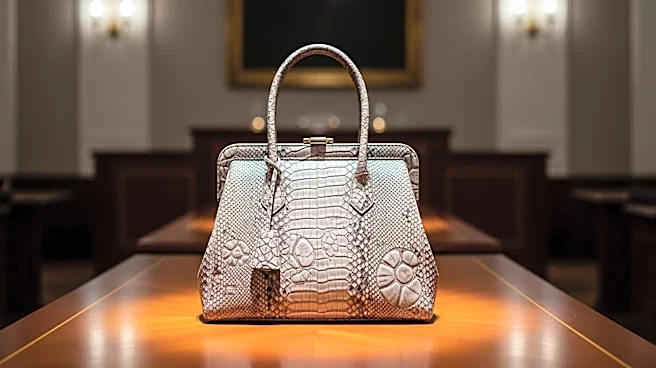
A handbag made from Tyrannosaurus rex cells failed to sell at an auction in Paris, despite being valued at 300,000 euros. The handbag, created from collagen remnants found in a T-Rex femur in Montana, USA, was unveiled in Amsterdam before the auction.
The auction house Drouot described it as a 'scientific feat' and an 'unprecedented object in the history of luxury,' highlighting its creation without reliance on animal husbandry. The handbag's starting price was 100,000 euros, but it did not exceed 150,000 euros during the sale. The material, termed 'cellular leather,' is distinct from vegan leather, as it is derived from cell culture to create authentic T-Rex skin.
Why It's Important?
The auction highlights the intersection of biotechnology and luxury fashion, showcasing how scientific advancements can lead to novel materials. The creation of 'cellular leather' represents a shift towards sustainable luxury, reducing reliance on traditional animal farming. This innovation could pave the way for more environmentally friendly fashion products, appealing to consumers seeking sustainable options. However, the failure to sell the handbag at its estimated value suggests that the market may not yet be ready to fully embrace such innovations, or that the price point was too high for potential buyers.
What's Next?
The auction's outcome may prompt further discussions within the luxury fashion industry about the viability and marketability of biotechnology-derived products. Companies might explore more affordable applications of cellular leather to increase consumer acceptance. Additionally, the scientific community may continue to refine and improve the technology, potentially leading to broader applications beyond fashion. The auction house and creators might also consider alternative marketing strategies to better communicate the value and uniqueness of such products to potential buyers.