

What's Happening?
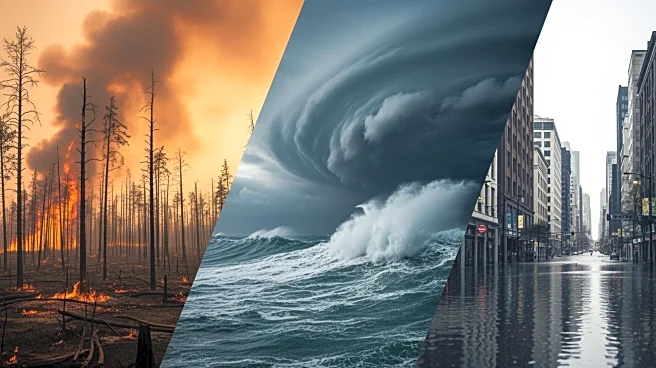
According to a report by Swiss Re Institute, wildfires, severe convective storms, and floods accounted for a record 92% of global natural catastrophe insured losses in 2025, totaling $107 billion. The report highlights that wildfires alone set a new loss record,
with the Palisades and Eaton fires in Los Angeles contributing $40 billion in insured losses. Severe convective storms, including hailstorms and damaging winds, resulted in $51 billion in losses, marking 2025 as the third costliest year for such storms. Despite these high figures, the total was below the $140 billion expected due to the absence of a major U.S. hurricane landfall. The report also notes that insured losses are rising by 5-7% annually, with projections suggesting they could reach $186 billion by 2030 if trends continue.
Why It's Important?
The findings underscore the increasing financial burden of natural disasters on the insurance industry and highlight the growing risk of wildfires as a significant factor in insured losses. This trend poses challenges for insurers in managing risk and pricing policies, particularly as climate change exacerbates the frequency and severity of such events. The report also points to significant protection gaps, especially in emerging economies where a large portion of catastrophe losses remain uninsured. This situation calls for enhanced adaptation measures and broader insurance coverage to mitigate financial impacts. In the U.S., where catastrophe losses are a major component of personal property insurance claims, targeted adaptation measures could help reduce insured losses.
What's Next?
The report suggests that addressing the structural upward trend in insured losses requires identifying and managing risk drivers before losses occur. This includes integrating insurance coverage with risk-adaptation measures in vulnerable areas. As exposure to natural disasters continues to build, the insurance industry and policymakers may need to collaborate on strategies to close protection gaps and enhance resilience against future events.