

What's Happening?
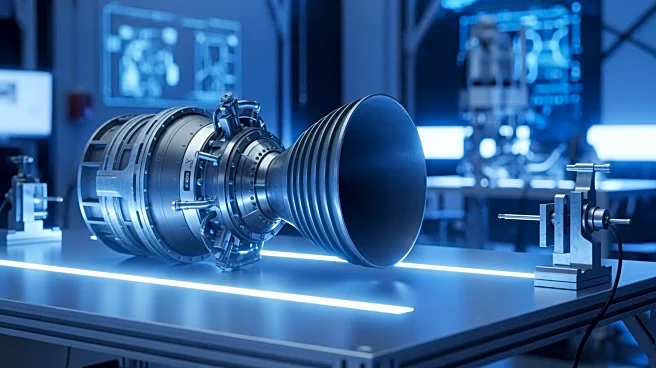
Arkadia Space, a Spanish propulsion startup, has secured €14.5 million in funding from the European Investment Council (EIC) to develop an advanced bipropellant propulsion system. This funding includes €2.5 million in grant funding and €6 million in equity
financing, matched by €6 million from a private investor. The company aims to use this investment to enhance its propulsion technology, which utilizes green propellants like hydrogen peroxide, to achieve higher thrust levels for future space missions. Arkadia's technology was previously validated during a spaceflight on a D-Orbit ION satellite carrier in March 2025, demonstrating its capability to generate 5 N of thrust. The new engine is expected to support higher-thrust missions and potentially serve as a propulsion system for lunar landings.
Why It's Important?
The development of Arkadia Space's bipropellant engine represents a significant advancement in space propulsion technology, particularly in the use of green propellants. This innovation could reduce the handling costs for satellite and spacecraft operators by providing a safer alternative to toxic hydrazine fuels. The successful implementation of this technology could position Arkadia as a key player in the European space industry, potentially leading to more contracts and collaborations. The funding from the EIC not only supports the technical development but also provides Arkadia with access to exclusive services and further capital opportunities, enhancing its growth potential in the competitive space sector.
What's Next?
Arkadia plans to use the secured funds to ramp up production of its engine systems and expand its fuel-production capabilities. The company envisions building a larger production facility to meet the increasing demand for its engines. With the backing of the EIC, Arkadia is poised to streamline its production processes and explore additional funding opportunities. The company has already signed an agreement to supply a 250-N version of its engine for MaiaSpace's launch vehicles, indicating a growing interest in its technology. As Arkadia continues to develop its propulsion systems, it may play a crucial role in future space missions, including potential lunar landings.