





What's Happening?
TerraBlaster, a startup leveraging technology initially used on the Mars rover, is advancing towards a commercial launch of its real-time soil nutrient mapping system by late 2026. The company, led by Jorge Heraud, has developed a prototype that uses
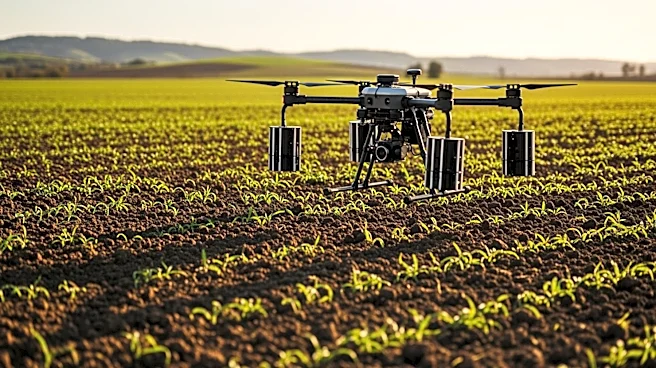
laser-induced breakdown spectroscopy (LIBS) to provide detailed soil nutrient maps. This technology, which can be attached to tractors or ATVs, measures key nutrients like nitrogen, phosphorus, and potassium in real time, allowing for more precise fertilizer application. TerraBlaster's system aims to replace traditional soil sampling methods, which are often slow and lack precision. The startup has already raised $4 million in a pre-seed round and is seeking an additional $10-15 million to scale its technology.
Why It's Important?
The introduction of TerraBlaster's technology could significantly impact the agricultural industry by enhancing precision agriculture practices. By providing real-time data on soil nutrient levels, farmers can optimize fertilizer use, potentially reducing costs and increasing crop yields. This innovation addresses the limitations of traditional soil sampling, which can be labor-intensive and less accurate. The ability to make immediate fertilizer decisions based on real-time data could lead to more sustainable farming practices and better resource management. As the agricultural sector faces increasing pressure to improve efficiency and sustainability, TerraBlaster's technology offers a promising solution.
What's Next?
TerraBlaster plans to conduct further testing of its second-generation prototype in the coming months, with additional validation work scheduled for the fall. The company is targeting agronomists and soil-testing service providers as its initial market. As the technology develops, it may also integrate with existing agricultural machinery for broader application. The success of TerraBlaster's upcoming funding round will be crucial for scaling production and refining the technology. If successful, this could lead to widespread adoption of real-time soil nutrient mapping in the agricultural industry.