





What's Happening?
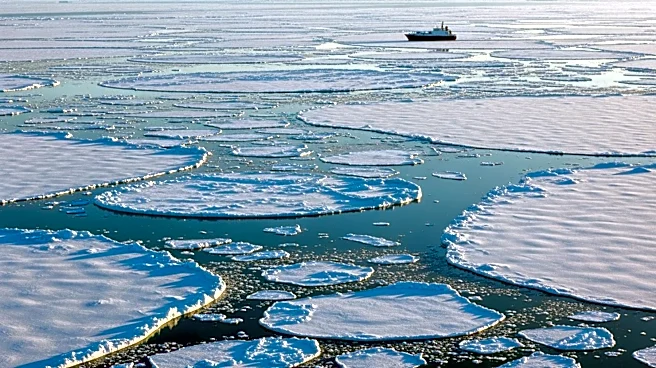
A recent report by credit insurance firm Coface indicates that while Arctic shipping routes have seen increased traffic, their commercial impact remains marginal, particularly for container ships. The report highlights that climate change has opened up
navigation in the Arctic, offering reduced sailing distances of up to 40% between East Asia and Northern Europe. However, the Arctic routes are primarily attracting the transport of raw materials, such as crude oil and LNG, due to cost savings. Despite the shorter distances, container shipping remains uncompetitive in the Arctic due to operational constraints and specific costs. The report suggests that only about 3.5% of trade between East Asia, Northern Europe, and North America is likely to use Arctic routes in the short term.
Why It's Important?
The findings underscore the limited commercial viability of Arctic shipping routes for container ships, despite the potential benefits of reduced sailing distances. This has implications for global trade, as traditional routes continue to dominate due to their economies of scale. The Arctic routes' focus on raw materials transport highlights opportunities for industries linked to energy, metals, and timber, which could benefit from cost savings. However, the limited use of these routes for container shipping suggests that significant changes in global trade patterns are unlikely in the near term. The report also emphasizes the political significance of Arctic routes, as countries may seek to assert influence in the region.
What's Next?
The continued development of Arctic shipping routes may lead to increased investment in infrastructure and technology to support navigation in the region. As climate change progresses, further exploration of these routes could occur, potentially altering global trade dynamics. However, significant challenges remain, including environmental concerns and the need for international cooperation to ensure safe and sustainable navigation. The focus on raw materials transport may drive further expansion in industries such as energy and mining, while container shipping may require technological advancements to become viable in the Arctic.