







What's Happening?
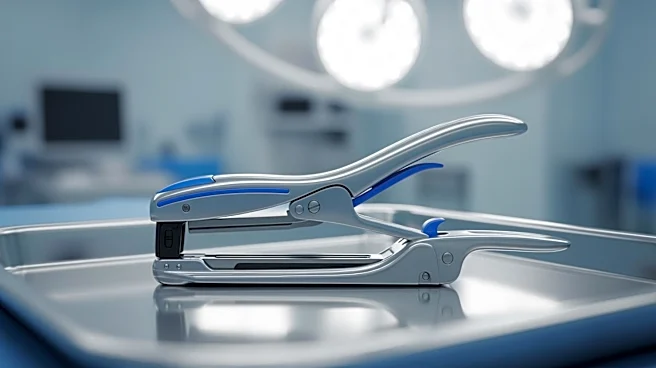
Johnson & Johnson has announced the European CE Mark approval for its new ETHICON 4000 Stapler, a significant advancement in surgical stapling technology. This stapler is designed to provide reliable staple line integrity across a wide range of tissue
thicknesses, applicable in both open and laparoscopic surgeries. The ETHICON 4000 features proprietary 3D Stapling Technology and enhanced Gripping Surface Technology, which are intended to optimize compression and manage various tissues across specialties such as bariatric, colorectal, and thoracic surgeries. The stapler is also planned for future integration with the OTTAVA Robotic Surgical System. This development aims to address surgical complications like leaks and bleeding, which can impact patient outcomes and incur significant costs.
Why It's Important?
The approval of the ETHICON 4000 Stapler is crucial as it represents a step forward in reducing surgical complications, which are a major concern in healthcare. Complications such as leaks and bleeding not only affect patient recovery but also lead to increased healthcare costs. By improving staple line integrity, the ETHICON 4000 aims to enhance surgical outcomes and reduce the need for additional interventions. This advancement is particularly significant in specialties where tissue variability poses challenges, potentially leading to better patient outcomes and cost savings. The integration of this technology with robotic systems like OTTAVA could further revolutionize surgical procedures, making them more efficient and less invasive.
What's Next?
With the CE Mark approval, Johnson & Johnson is poised to introduce the ETHICON 4000 Stapler across the European Union, potentially setting a precedent for future approvals in other regions, including the U.S. The company plans to integrate this technology with the OTTAVA Robotic Surgical System, which is still under development. This integration could lead to more widespread adoption of robotic-assisted surgeries, offering enhanced precision and reduced recovery times for patients. As the healthcare industry continues to evolve, the focus will likely remain on innovations that improve patient outcomes while managing costs effectively.