




What's Happening?
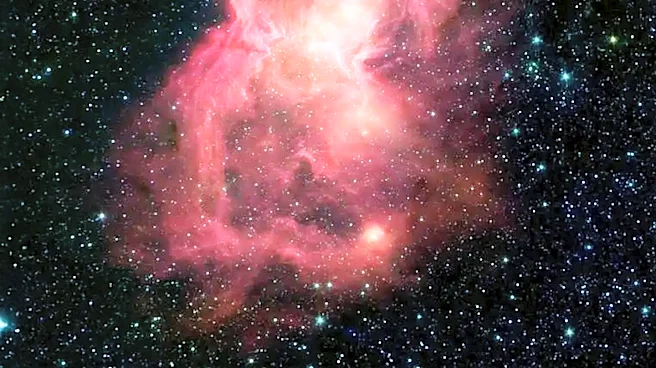
Astronomy enthusiasts are encouraged to observe NGC 2359, a nebula in the constellation Canis Major, on May 4. Known as Thor’s Helmet, this nebula is also affectionately called the Baby Yoda Nebula due to its resemblance to the popular Star Wars character
Grogu. The nebula is located near the star WR7, a massive Wolf-Rayet star, which is shedding material that forms the nebula. Observers can find NGC 2359 by locating Sirius, the brightest star in the sky, and moving northeast. The nebula appears as a small fuzzy patch in smaller telescopes, while larger telescopes reveal more of its structure, resembling Grogu’s head and ears.
Why It's Important?
The observation of NGC 2359 offers both amateur and professional astronomers a chance to study a Wolf-Rayet star and its surrounding nebula. These stars are significant because they are massive and short-lived, often ending their life cycles in supernova explosions. Understanding these stars and their nebulae can provide insights into stellar evolution and the processes that lead to supernovae. Additionally, the cultural connection to Star Wars through the Baby Yoda nickname may inspire broader public interest in astronomy, encouraging more people to engage with scientific observation and exploration.
What's Next?
As the nebula is best viewed shortly after sunset, astronomers and enthusiasts are likely to plan their observations around this time. The continued study of NGC 2359 and similar nebulae will contribute to the broader understanding of stellar life cycles. Public interest may also lead to increased participation in astronomy clubs and events, fostering a community of enthusiasts who share observations and findings. Future advancements in telescope technology could allow for even more detailed studies of such celestial objects.
Beyond the Headlines
The nickname 'Baby Yoda Nebula' highlights the intersection of popular culture and science, demonstrating how cultural references can make scientific phenomena more accessible and engaging to the public. This blending of science and culture can play a crucial role in science communication, making complex topics more relatable and encouraging a wider audience to explore scientific fields. The phenomenon also underscores the importance of creative approaches in education and public outreach.