


What's Happening?
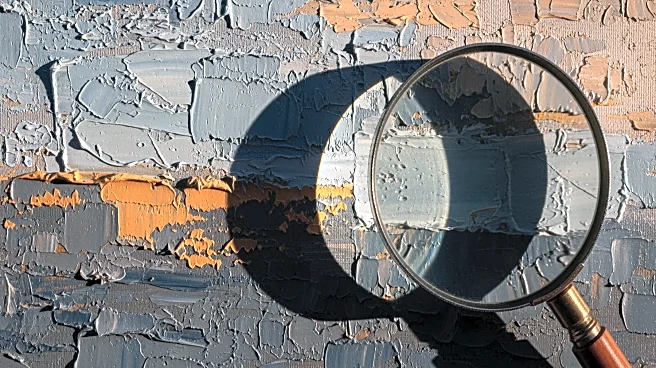
Patrick Quéré, an American based in Hollywood, Florida, claims to have discovered hidden details in the paintings of 20th-century artist Nicolas de Staël. Quéré's interest began with a small painting titled 'La Clé' ('The Key'), which he attributes to de Staël and claims was a gift to his grandfather. Quéré believes that de Staël encrypted his name within the geometric patterns of his paintings, a theory he developed using numerology, topography, cryptography, and math. Despite Quéré's assertions, the art establishment has been skeptical, as 'The Key' is not listed among de Staël's official works. Art historians and institutions have not officially supported Quéré's claims, and the painting has not been authenticated by the Comité Nicolas de Staël.
Why It's Important?
The claims made by Quéré could potentially alter the understanding of Nicolas de Staël's work, offering a new perspective on the artist's intentions and methods. If proven true, this discovery could impact the valuation and interpretation of de Staël's paintings, influencing art historians, collectors, and museums. However, the lack of official recognition and authentication poses challenges to the acceptance of Quéré's theory. The skepticism from the art community highlights the difficulties in altering established narratives within art history, especially when dealing with posthumous claims and unsigned works.
What's Next?
Quéré hopes to see an exhibition of de Staël's encrypted paintings, accompanied by diagrams showing how to decipher them. He also wishes for 'The Key' to be acquired by a museum for public display. The ongoing debate over the authenticity of Quéré's claims may continue to engage art historians and enthusiasts, potentially leading to further research and analysis of de Staël's works. The outcome of this debate could influence future exhibitions and the scholarly approach to de Staël's legacy.