



What's Happening?
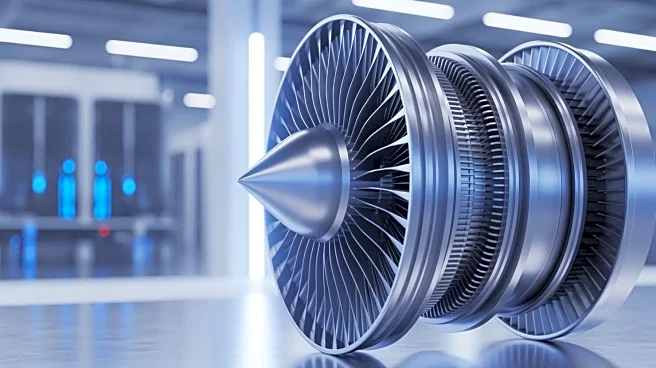
FTAI Aviation, a New York-based maintenance, repair, and overhaul specialist, has announced the development of a new aeroderivative gas turbine based on the CFM56 engine family. This new turbine, named FTAI Power, is designed to meet the growing energy demands of AI datacenters. The 25-megawatt turbine will be produced using remanufactured CFM56 engines, which have been previously used in operational service. FTAI's COO, David Moreno, highlighted the urgent need for immediate power solutions driven by the accelerating demand from AI hyperscalers. The company plans to leverage its existing fleet of over 1,000 engines and future engine pipeline to produce these turbines predictably and cost-effectively. FTAI Power aims to deliver over 100 units
annually, positioning itself as a critical partner for the AI economy.
Why It's Important?
The development of the FTAI Power turbine represents a significant advancement in meeting the energy needs of AI datacenters, which require substantial and flexible power solutions. This move could potentially disrupt the global gas turbine industry, which is projected to be valued at $84.5 billion by 2030. By utilizing remanufactured engines, FTAI is not only addressing the immediate power demands but also promoting sustainability through the reuse of existing resources. This initiative could challenge established players in the aeroderivative market, such as GE Vernova and Mitsubishi Power, by offering a cost-effective and efficient alternative. The success of FTAI Power could lead to further innovations and adaptations of aeroengines for industrial power applications.
What's Next?
FTAI Aviation's next steps involve scaling up production to meet the anticipated demand for the FTAI Power turbines. The company will need to ensure that its supply chain and maintenance capabilities can support the increased production volume. Additionally, FTAI may explore further adaptations of other aeroengine models to expand its product offerings. The response from competitors and the broader market will be crucial in determining the long-term impact of this development. Stakeholders in the AI and energy sectors will likely monitor the performance and reliability of these turbines closely.