







What's Happening?
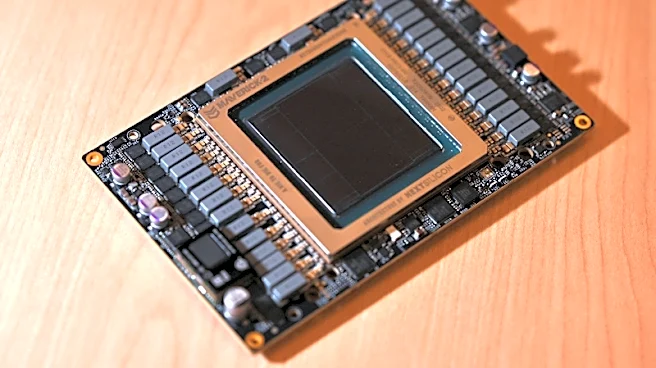
Nvidia's CEO Jensen Huang has announced a significant new market opportunity for the company, valued at $200 billion, centered around its new CPU product, Vera. This announcement came during an earnings call where Nvidia reported record-breaking revenue
of $81.6 billion, with a forecast of $91 billion for the next quarter. The Vera CPU, introduced in March, is designed specifically for agentic AI, a growing field where CPUs are used to perform tasks assigned by AI models. Huang emphasized that Vera is the world's first CPU purpose-built for this type of AI, and it has already generated $20 billion in sales. Nvidia, traditionally known for its dominance in the GPU market, is now positioning itself as a key player in the CPU market, challenging established companies like Intel and AMD.
Why It's Important?
This development is significant as it marks Nvidia's strategic expansion into the CPU market, traditionally dominated by other tech giants. By targeting the agentic AI sector, Nvidia is tapping into a rapidly growing area of technology that could redefine computing. The success of Vera could potentially shift market dynamics, offering Nvidia a substantial new revenue stream and reinforcing its position as a leader in AI technology. This move also highlights the increasing convergence of AI and traditional computing, with Nvidia at the forefront of this transition. The company's ability to capture a significant share of this new market could have wide-ranging implications for the tech industry, influencing competition and innovation.
What's Next?
As Nvidia continues to roll out its Vera CPU, the company is likely to face competition from other tech giants and startups developing AI chips. The success of Vera will depend on its adoption by major cloud providers and system makers, who are already partnering with Nvidia. The broader tech industry will be watching closely to see if Nvidia can maintain its momentum and expand its influence in the CPU market. Additionally, the development of agentic AI and its applications could lead to new opportunities and challenges for businesses and consumers alike.