






What's Happening?
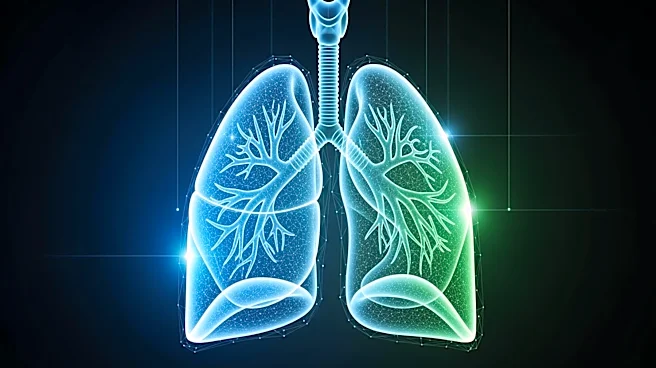
Ebenbuild GmbH, a healthcare technology company based in Munich, has published a validation study in Nature Communications Medicine, confirming the accuracy of its lung digital twin technology. This technology is designed to predict the deposition patterns
of inhaled drugs within the lungs with high spatial resolution. The study compared the digital twin's predictions with in vivo 3D SPECT/CT imaging, a standard in measuring pulmonary drug distribution, achieving a high correlation coefficient of 0.95. This advancement addresses the challenges of drug delivery in the lungs, which are complicated by the variability in lung anatomy and disease-induced changes. Ebenbuild's technology converts CT scans into detailed computational models that simulate airflow and particle transport, offering a comprehensive view of drug dynamics across the entire respiratory tract.
Why It's Important?
The validation of Ebenbuild's digital twin technology represents a significant step forward in respiratory medicine and drug development. By providing precise predictions of drug deposition, this technology can enhance the development of inhaled therapies, potentially leading to more effective treatments with reduced variability in patient responses. It also supports the trend towards personalized medicine, allowing for tailored therapeutic regimens based on individual patient anatomy and disease state. The technology's ability to simulate drug delivery in conditions like idiopathic pulmonary fibrosis highlights its potential to improve treatment strategies for complex respiratory diseases. Furthermore, the study strengthens the case for regulatory acceptance of computational modeling in drug evaluation, which could streamline the development and approval of new therapies.
What's Next?
Ebenbuild plans to expand the application of its digital twin technology beyond drug delivery. The company is developing clinical applications, such as AEROGRAM, to assist in ventilatory support strategies for patients in intensive care. As computational power and imaging techniques continue to advance, digital twins could become integral to clinical workflows, providing real-time insights into lung function and treatment responses. This could lead to broader adoption of in silico methods in clinical practice and regulatory science, furthering the integration of digital health innovations in respiratory medicine.
Beyond the Headlines
The successful validation of Ebenbuild's technology underscores the potential of digital twins to transform healthcare by integrating biomedical engineering, artificial intelligence, and clinical science. This convergence could lead to new standards in precision medicine, where treatments are tailored to the unique physiological contexts of individual patients. As digital twin technology becomes more prevalent, it may also influence the design of medical devices and the development of new diagnostic tools, ultimately enhancing patient care and outcomes.