



What's Happening?
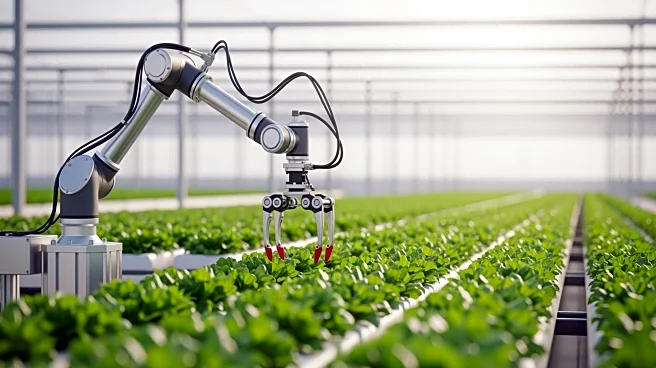
The global agricultural robots market is anticipated to grow significantly, from $10.183 billion in 2025 to $28.204 billion by 2030, reflecting a compound annual growth rate (CAGR) of 22.60%. This growth is driven by the increasing need for automation in agriculture to enhance productivity and meet the rising food demand due to global population expansion. Agricultural robots are designed to perform various tasks such as harvesting, weed control, and autonomous mowing, which help farmers optimize production. The market is also supported by government incentives like low-interest loans and subsidies, particularly in developing countries, which encourage the adoption of agricultural technology.
Why It's Important?
The expansion of the agricultural robots market is
crucial for addressing the challenges posed by a growing global population and the corresponding increase in food demand. As traditional farming methods struggle to meet these demands, automation offers a viable solution to enhance productivity and efficiency in agriculture. The integration of technologies such as the Internet of Things (IoT) and real-time navigation systems in farm machinery further boosts operational efficiency, allowing for data-driven decision-making. This technological advancement not only supports food security but also transforms agriculture into a more mechanized and commercial sector, potentially leading to economic growth, especially in regions heavily reliant on agriculture.
What's Next?
The agricultural robots market is expected to continue its growth trajectory, with North America projected to hold the largest market share due to the increasing penetration of automated farm equipment. Meanwhile, countries like China and Japan are emerging as significant markets in the Asia-Pacific region, driven by agricultural modernization initiatives. However, challenges such as high costs and limited understanding of new technologies, particularly in developing countries, may hinder market expansion. Addressing these barriers through technological simplification and regulatory frameworks will be essential for the widespread adoption of agricultural robots.
Beyond the Headlines
The rise of agricultural robots also raises concerns about data privacy and the need for comprehensive regulatory frameworks to ensure safe and effective deployment. As the market grows, it will be important to address these issues to prevent potential setbacks in technology adoption. Additionally, the shift towards automation in agriculture could have socio-economic implications, such as changes in labor dynamics and the need for new skill sets among the agricultural workforce.