
What's Happening?
Data centers in the U.S. are undergoing significant architectural changes to accommodate the growing power demands driven by artificial intelligence (AI) applications, machine learning, and high-performance
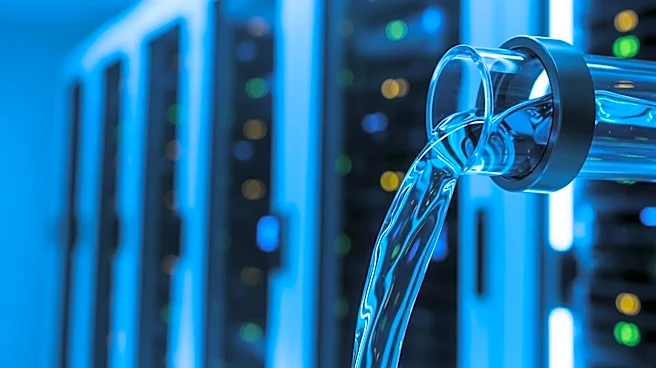
computing. The International Energy Agency (IEA) projects that data center power needs in the U.S. will triple from 2024 levels by 2030. This surge is primarily due to the increased computational power required by advanced chips, which also generate more heat. As a result, data centers are transitioning from traditional air cooling systems to more efficient liquid cooling methods. Liquid cooling, which uses highly purified water or water-glycol mixtures, offers superior heat-transfer performance compared to air cooling. This shift is essential to manage the increased thermal output from high-power chips and to cool greater server rack densities in smaller spaces.
Why It's Important?
The transition to liquid cooling in data centers is crucial for maintaining operational efficiency and sustainability. As AI and high-performance computing become more integral to various industries, the demand for data processing power continues to rise. Efficient cooling systems are necessary to prevent hardware damage and ensure uptime, which is critical for service level agreements with end users. Moreover, liquid cooling systems help reduce the overall energy consumption of data centers, which is significant given that cooling accounts for a large share of their power use. By improving cooling efficiency, data centers can lower utility costs and their carbon footprint, aligning with broader sustainability goals. This shift also highlights the need for advanced instrumentation and process control to manage the complexities introduced by liquid cooling systems.
What's Next?
As data centers continue to adopt liquid cooling systems, there will be a growing demand for advanced instrumentation and process control technologies to ensure efficient operation. Facility operators will need to invest in industrial-grade technology to replace less reliable commercial-grade devices. This includes the use of advanced flowmeters and non-invasive temperature sensors to optimize thermal setpoints and energy consumption. Additionally, data centers will need to address cybersecurity concerns by using devices with wireless connectivity deactivated in sensitive environments. The industry will also see an increased focus on predictive maintenance practices, enabled by modern instruments with integrated diagnostic capabilities. These developments will be crucial for data centers to meet the rising computational demands while maintaining energy efficiency and reliability.