
What's Happening?
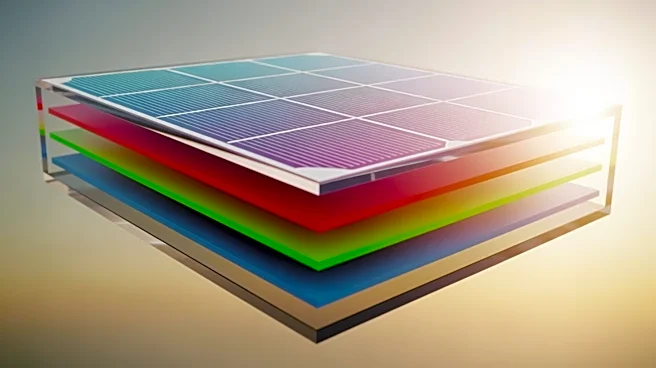
A recent study has explored the development of stable and efficient lead-free perovskite solar cells, focusing on Sn-based perovskites. These materials are being studied as alternatives to lead-based solar cells due
to their lower toxicity and potential for high efficiency. The research highlights various strategies to improve the performance of Sn-based perovskites, such as defect management, surface passivation, and controlled crystallization. Despite their advantages, these solar cells face challenges like instability and high defect density. The study suggests that with further development, lead-free perovskites could become a viable option for sustainable solar energy.
Why It's Important?
The push for lead-free perovskite solar cells is driven by the need for environmentally friendly and sustainable energy solutions. As the demand for renewable energy sources grows, finding alternatives to toxic materials like lead is crucial. The advancements in Sn-based perovskites could lead to more widespread adoption of solar technology, reducing reliance on fossil fuels and decreasing environmental impact. This research could pave the way for new manufacturing techniques and materials that enhance the efficiency and stability of solar cells, making them more accessible and affordable.
What's Next?
Future research will likely focus on overcoming the current limitations of Sn-based perovskites, such as improving their stability and reducing defect density. Continued innovation in material engineering and fabrication techniques will be essential to achieving these goals. As these technologies advance, they may attract more investment and interest from the renewable energy sector, potentially leading to commercial applications. Collaboration between researchers, industry, and policymakers will be crucial to accelerate the development and deployment of lead-free solar technologies.