







What's Happening?
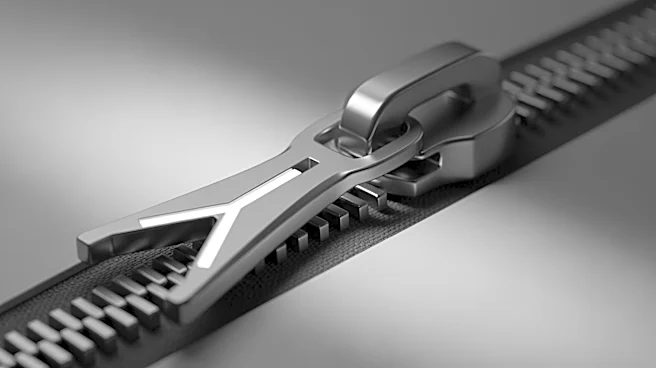
In 1985, Bill Freeman, an electrical engineer at Polaroid, developed a concept for a three-sided zipper capable of transforming objects from soft, flexible states to rigid, load-bearing structures. Despite being initially rejected by a design competition,
Freeman patented the idea and stored it away for decades. Now, researchers at MIT's Computer Science and Artificial Intelligence Laboratory (CSAIL) have brought this concept to life with the Y-Zipper. This 3D-printed fastener can convert flexible strips into a rigid rod with a simple zip, offering a reversible solution to previous challenges in creating structures with tunable stiffness. The Y-Zipper's potential applications are vast, ranging from camping gear to medical equipment and even space exploration.
Why It's Important?
The Y-Zipper represents a significant advancement in materials science, challenging the traditional notion that materials must be either rigid or flexible. This innovation could revolutionize various industries by providing a versatile tool for creating adaptable structures. The ability to switch between states could lead to more efficient designs in fields such as disaster relief, where portable yet sturdy structures are crucial. Additionally, the development of an automated design system around the Y-Zipper makes this technology accessible and repeatable, potentially leading to widespread adoption and new applications.
What's Next?
Currently, the Y-Zipper is limited to plastic filaments, but future developments could include metal versions for increased durability and strength. The MIT team is also working on scaling up the technology for larger structures. As the Y-Zipper gains attention, it may inspire further research and innovation in adaptable materials, potentially leading to new breakthroughs in engineering and design.