





What's Happening?
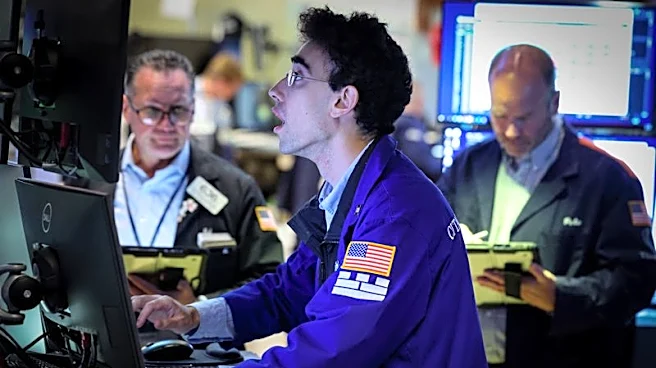
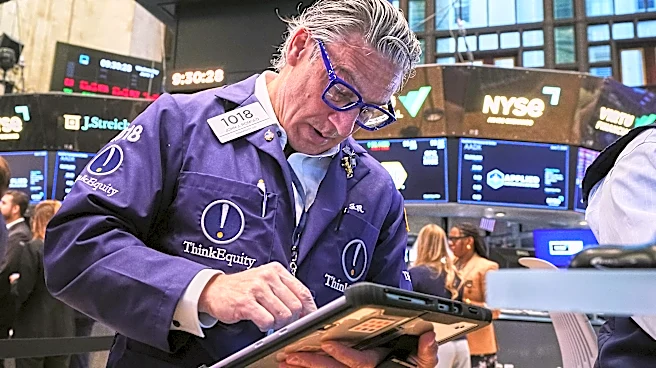
Jim Cramer, host of CNBC's 'Mad Money', has observed a significant shift in investor behavior as they move away from riskier market sectors. On a recent trading day, all three major U.S. stock indices—Dow Jones Industrial Average, S&P 500, and Nasdaq
Composite—closed lower, with declines of 1.87%, 1.62%, and 1.98% respectively. Cramer noted that investors are increasingly favoring defensive stocks, such as real estate investment trusts, insurers, and consumer staples, which are perceived as safer investments. This trend is evident in the S&P 500's list of stocks reaching 52-week highs, which is dominated by these lower-risk sectors. Notably, technology stocks, which have been a major driver of market growth, are less represented in this list, with only a few exceptions like semiconductor equipment makers Applied Materials and KLA Corp.
Why It's Important?
The shift towards defensive stocks indicates a broader market sentiment of caution and risk aversion. This change could have significant implications for the U.S. economy and investors. Defensive stocks typically perform better during periods of economic uncertainty or downturns, suggesting that investors may be preparing for potential economic challenges. This trend could impact the performance of high-growth sectors, particularly technology, which have been pivotal in driving market gains in recent years. The move away from riskier investments could also affect the capital available for innovation and expansion in these sectors, potentially slowing economic growth.
What's Next?
If the trend towards defensive stocks continues, it could lead to a reallocation of investment capital across different sectors, potentially stabilizing some areas of the market while putting pressure on others. Investors and market analysts will likely monitor economic indicators and Federal Reserve policies closely, as these could influence market dynamics further. Additionally, any geopolitical developments, such as U.S.-Iran tensions, could exacerbate market volatility and reinforce the preference for safer investments.