


What's Happening?
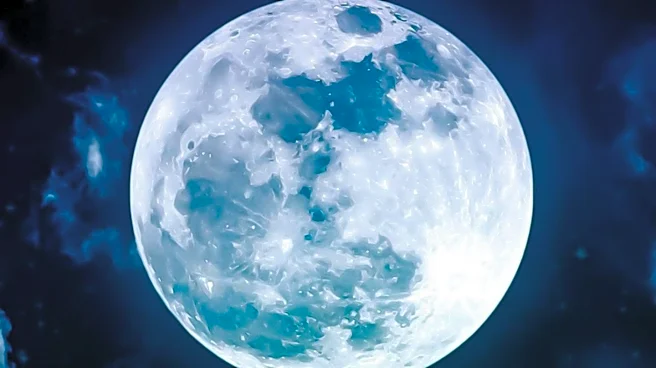
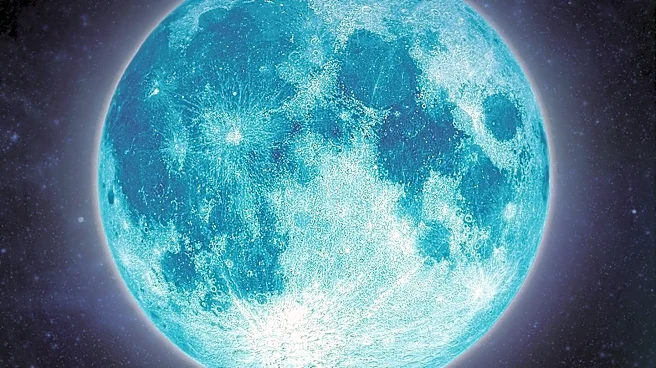
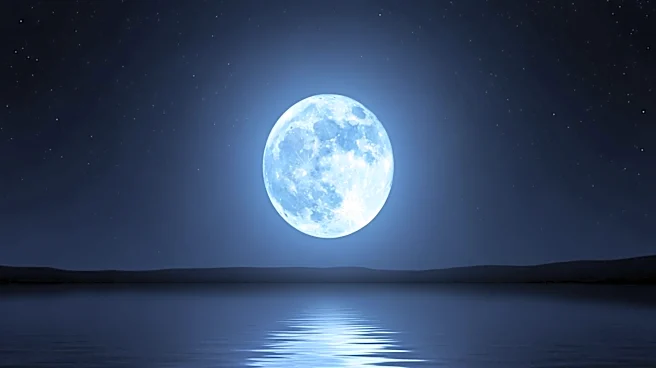
A blue moon, the second full moon in a single month, will be visible this weekend, offering a rare celestial event that occurs approximately every two to three years. Despite its name, the moon will not appear blue but will maintain its usual silvery
white or golden hue. The term 'blue moon' has historical roots dating back to the 1500s and was popularized by the 1937 Maine Farmer's Almanac. This particular blue moon will also be a micromoon, appearing smaller due to its distance from Earth. The event will be most visible in the Americas, Africa, and Europe on the night of May 30, and in Australia, New Zealand, and Asia on May 31.
Why It's Important?
The blue moon is a significant astronomical event that captivates public interest and encourages engagement with the natural world. It provides an opportunity for educational outreach and public participation in astronomy, fostering a greater appreciation for celestial phenomena. The event also serves as a reminder of the intricate dynamics of the lunar cycle and its impact on cultural and scientific understanding. For photographers and sky watchers, the blue moon offers a unique chance to capture and share the beauty of the night sky. This event highlights the importance of preserving dark skies and reducing light pollution to ensure continued enjoyment of such natural spectacles.
What's Next?
Following the blue moon, astronomers and enthusiasts will continue to monitor and study lunar cycles and their effects on Earth. The next occurrence of a blue moon will be anticipated by both the scientific community and the public, with future events providing further opportunities for observation and research. Efforts to educate the public about lunar phenomena will persist, aiming to inspire interest in astronomy and science. Additionally, discussions around light pollution and its impact on astronomical observations may gain traction, encouraging initiatives to protect and preserve the visibility of celestial events for future generations.