







What's Happening?
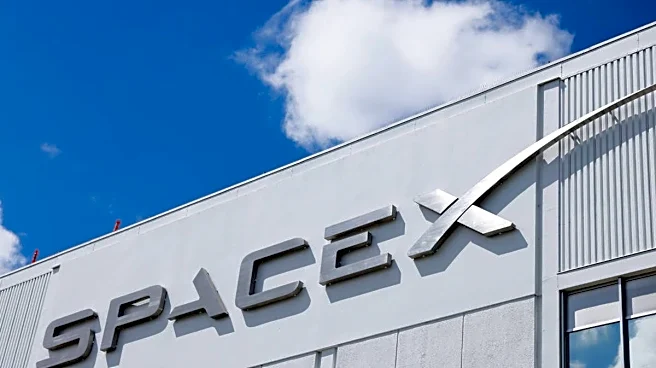
SpaceX, the aerospace company founded by Elon Musk, has officially filed for an initial public offering (IPO) with the U.S. Securities and Exchange Commission. The company plans to list on the Nasdaq under the ticker 'SPCX'. Elon Musk, who holds 85.1%
of the voting rights, will continue to play a central role as CEO, CTO, and Chairman of the Board. The IPO is anticipated to be one of the largest in history, potentially raising around $75 billion and valuing the company at approximately $1.75 trillion. The filing reveals detailed insights into SpaceX's operations, including its financial performance and strategic plans. SpaceX reported a revenue of $4.69 billion in the first quarter of 2026, alongside a net loss of $4.27 billion. The company's satellite internet service, Starlink, is projected to generate significant revenue, while the integration of Musk's AI company, xAI, is expected to bring both growth opportunities and substantial expenses.
Why It's Important?
The IPO of SpaceX marks a significant milestone in the commercial space industry, potentially setting a new benchmark for valuations and capital raising. With Elon Musk retaining a strong influence over the company, SpaceX's strategic direction will likely continue to align with his vision of space exploration and technological innovation. The funds raised from the IPO could accelerate SpaceX's ambitious projects, including the development of the Starship rocket and the expansion of Starlink. This move could also impact the competitive landscape, as SpaceX's financial strength and technological advancements may pressure other players in the aerospace and satellite internet sectors. Additionally, the integration of AI capabilities through xAI could position SpaceX as a leader in space-based AI applications, further diversifying its business model.
What's Next?
Following the IPO, SpaceX is expected to focus on executing its growth strategies, including the deployment of the Starship for payload transportation and the expansion of Starlink's satellite network. The company plans to begin using Starship for launching satellites in the latter half of 2026 and for next-generation mobile satellites in 2027. The success of these initiatives will be crucial for SpaceX's future growth and profitability. Additionally, the company is exploring future markets such as space tourism, intercity travel using Starship, and even asteroid mining. These ventures, while speculative, could open new revenue streams and further solidify SpaceX's position as a leader in the space industry.
Beyond the Headlines
The IPO filing highlights the significant influence Elon Musk will continue to wield over SpaceX, raising questions about corporate governance and decision-making processes. Musk's control over the company could impact investor confidence, as his leadership style and strategic decisions have historically been both innovative and controversial. Furthermore, the integration of AI into SpaceX's operations presents ethical and regulatory challenges, particularly in the context of space-based AI applications. As SpaceX ventures into new markets, it will need to navigate complex legal and regulatory landscapes, both domestically and internationally.