






What's Happening?
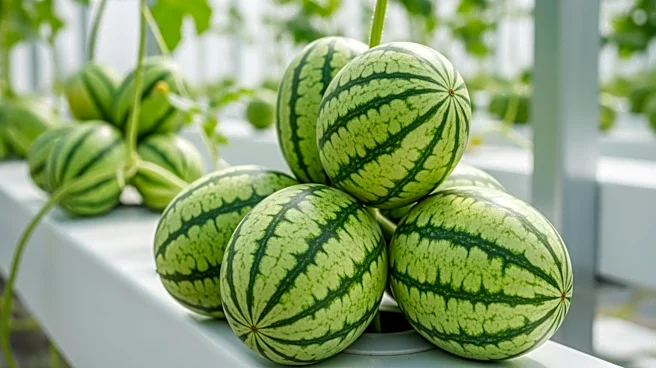
A family-led breeding effort in Northern Virginia, spearheaded by high school researcher Delaney Raptis and her mother, has resulted in the development of ultra-small watermelons. These watermelons, weighing between 80 to 200 grams, are designed to be compatible
with high-density greenhouse systems and vertical farms. Traditional watermelon varieties have posed challenges in such environments due to their large size and extensive vine growth. The new, smaller watermelons aim to address these issues by reducing spatial requirements and improving system compatibility. The breeding program, initiated in 2021, employs a non-GMO chemical mutation approach to ensure the stability of the reduced fruit size across generations.
Why It's Important?
The development of these egg-sized watermelons is significant for the future of controlled environment agriculture, particularly in urban settings where space is limited. By enabling higher planting densities, these watermelons could make vertical farming more viable and efficient, maximizing output per square meter. This innovation aligns with the growing trend of urban agriculture and the need for sustainable food production methods. Additionally, the smaller fruit size may cater to changing consumer preferences for single-portion produce, potentially reducing food waste and offering convenience for urban consumers and smaller households. The project also opens up new possibilities for hybrid breeding programs, providing breeders with tools to target specific size segments.
What's Next?
The next steps involve increasing seed stock for formal trials and evaluating the performance of these watermelons across different growing systems. Collaboration with industry stakeholders and growers will be crucial to determine the practical applications of these watermelons at a commercial scale. Further research may also explore the relationship between fruit size and seed development, as preliminary observations suggest that seeds from the smallest fruits are also reduced in size. These efforts aim to integrate the ultra-small watermelon lines into formal breeding pipelines and assess their potential benefits for both commercial production and urban agriculture.