
What's Happening?
Researchers have assessed the effectiveness of a surface-deployed distributed acoustic sensing (DAS) array for deep mineral exploration in the Bergslagen mining district of central Sweden. The study focused
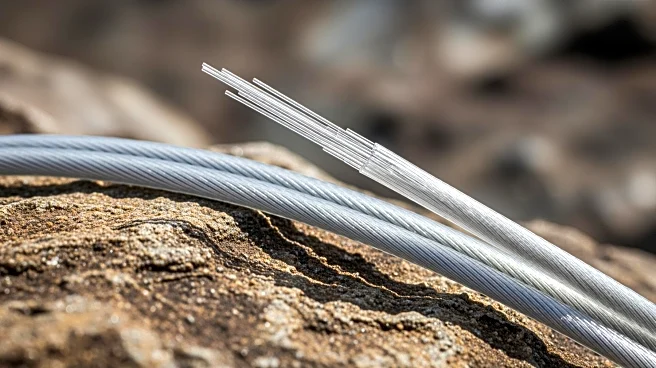
on the Blötberget deposit, known for its high-grade iron-oxides and potential rare-earth elements. The DAS array, consisting of a 2.2-km telecom fiber-optic cable, was used alongside MEMS receivers and geophones to collect seismic data. The study aimed to compare the DAS array's performance with traditional seismic methods. Despite challenges with noise and data quality, the DAS array successfully imaged the ore body and key geological structures, demonstrating its potential for mineral exploration.
Why It's Important?
The use of DAS technology in mineral exploration offers a cost-effective and efficient alternative to traditional seismic methods. Its ability to provide high-resolution imaging of subsurface structures can significantly enhance mineral exploration efforts, particularly in hard rock environments. The successful application of DAS in this study highlights its potential to improve the accuracy and efficiency of mineral targeting, which is crucial for the mining industry. As demand for minerals and rare-earth elements continues to rise, innovative exploration techniques like DAS could play a vital role in meeting global resource needs.
What's Next?
Further research and development are needed to optimize DAS technology for mineral exploration. Improvements in data processing and noise reduction techniques could enhance the quality and reliability of DAS data. Additionally, expanding the use of DAS in different geological settings and mineral deposits could provide valuable insights into its broader applicability. As the mining industry seeks to increase efficiency and reduce environmental impact, DAS technology could become an integral part of exploration strategies, driving advancements in resource discovery and extraction.