
What's Happening?
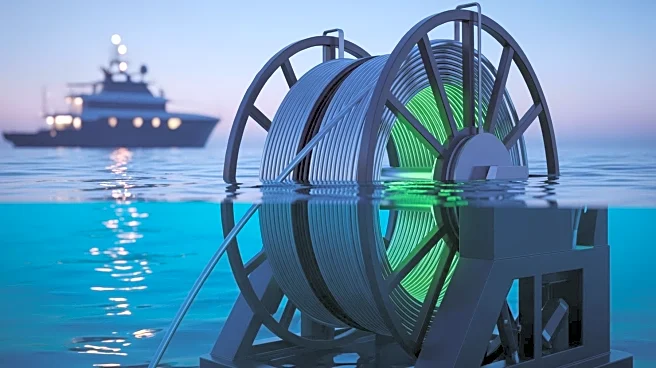
Kongsberg Maritime has been chosen to supply a comprehensive and integrated equipment package for a new ultra-large cable lay vessel being constructed for LS Marine Solutions at Tersan Shipyard in Türkiye. This vessel, set to be one of the largest of its
kind globally, is designed to meet the increasing demand for laying subsea high-voltage direct current (HVDC) and optical cables. The vessel will measure 148.4 meters in length and 31 meters in width, with a cable carrying capacity of 13,000 tons and a total displacement of 18,800 tons. Kongsberg Maritime's package includes dynamic positioning systems, integrated control and navigation systems, a battery hybrid DC electrical system, and all main propulsion and thruster units. The construction is expected to take three years, with the vessel entering operation in 2028.
Why It's Important?
This development is significant as it highlights the growing global demand for advanced subsea cable laying capabilities, driven by the expansion of renewable energy infrastructure. The vessel's advanced technology, including its battery hybrid DC power and propulsion system, aligns with global environmental, social, and governance (ESG) standards by reducing greenhouse gas emissions. This positions the vessel as a crucial component in the sustainable expansion of HVDC grids and offshore renewable energy projects. The collaboration between Kongsberg Maritime and LS Marine Solutions underscores the importance of technological innovation in supporting the transition to sustainable energy solutions.
What's Next?
The construction of the vessel at Tersan Shipyard will proceed over the next three years, with a focus on integrating Kongsberg Maritime's advanced systems to ensure operational efficiency and environmental compliance. As the vessel is set to enter operation in 2028, it will play a pivotal role in supporting the global demand for renewable energy infrastructure. Stakeholders in the maritime and renewable energy sectors will likely monitor the project's progress closely, as it represents a significant advancement in cable laying technology and sustainable maritime operations.
Beyond the Headlines
The project reflects a broader trend in the maritime industry towards integrating advanced technologies to enhance operational efficiency and reduce environmental impact. The use of battery hybrid systems and high-capacity shore connections for zero-emission operations during port stays exemplifies the industry's commitment to sustainability. Additionally, the vessel's capability to support floating wind farms with innovative cable pull-in systems highlights the potential for further advancements in offshore renewable energy projects.