
What's Happening?
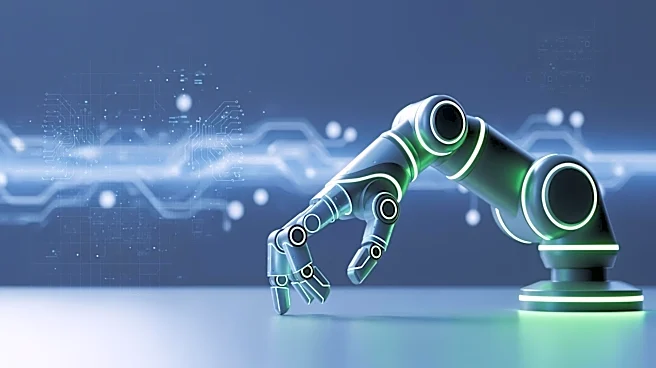
Nvidia has announced a partnership with Chinese humanoid robot maker Unitree to develop a new robotics system aimed at research institutions such as Stanford and ETH Zurich. The system features Unitree's H2 humanoid robot, which stands nearly six feet
tall, and incorporates Nvidia's Jetson Thor hardware, including the advanced Blackwell GPU for on-device artificial intelligence capabilities. This collaboration also includes Nvidia's humanoid-focused AI models, known as Isaac GR00T, and simulation systems. The robot is equipped with mechanical hands produced by Singapore-based Sharpa. Nvidia CEO Jensen Huang highlighted the potential of 'physical AI' to become a market worth tens of trillions of dollars, predicting significant growth in the robotics sector over the next five years.
Why It's Important?
This development signifies a major step forward in the field of robotics and artificial intelligence, with Nvidia leveraging its advanced GPU technology to enhance humanoid robotics capabilities. The collaboration with Unitree and the integration of sophisticated AI models could accelerate advancements in robotics research, potentially leading to breakthroughs in automation and AI applications. The involvement of prestigious research institutions like Stanford and ETH Zurich underscores the system's potential impact on academic and scientific research. As Nvidia positions itself at the forefront of the robotics market, this initiative could drive innovation and economic growth in the tech industry, influencing sectors ranging from manufacturing to healthcare.
What's Next?
As Nvidia and Unitree roll out this new robotics system, research institutions are expected to begin testing and developing applications for the technology. The success of this initiative could lead to further collaborations and advancements in humanoid robotics. Nvidia's prediction of rapid growth in the robotics segment suggests that additional investments and developments in this area are likely. Stakeholders in the tech industry, including investors and developers, will be closely monitoring the system's performance and potential applications, which could shape the future of robotics and AI integration across various industries.