



What's Happening?
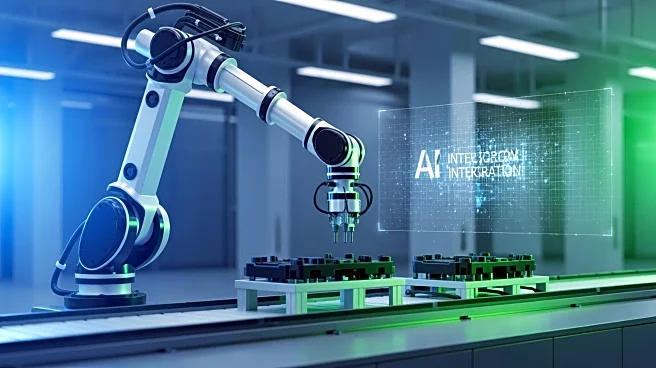
FANUC, a leading provider of factory robots and automation systems, has partnered with NVIDIA to introduce 'physical AI' into mainstream manufacturing. This collaboration aims to revolutionize smart factories by integrating NVIDIA's advanced AI computing stack, including on-robot systems like NVIDIA Jetson and simulation platforms such as NVIDIA Isaac Sim, into FANUC robots. The partnership will also support the open-source robotics platform ROS 2, allowing programming via Python, which lowers the barrier for developers and companies to build AI-driven robotics applications. This integration will enable the creation of high-fidelity digital twins, virtual replicas of factories and robot fleets, which can be used for training, testing, and optimization
before any physical robot investment. The collaboration promises to enhance the adaptability and safety of robots, allowing them to interpret voice commands and respond to dynamic environments.
Why It's Important?
The integration of physical AI into manufacturing processes is significant as it addresses the need for flexibility in modern factories. Traditional factory automation relied on pre-programmed robots for repetitive tasks, requiring manual reprogramming for changes, which led to downtime. The FANUC/NVIDIA collaboration aims to eliminate this issue by enabling robots to adapt to changing production demands without major overhauls. This development is crucial for manufacturers facing shifting supply chains and production demands, as AI-enabled robots can quickly switch between different product variants. Additionally, the use of open platforms like ROS 2 and Python could drive innovation, allowing firms to customize AI-augmented robotics solutions and leverage their software expertise.
What's Next?
FANUC plans to showcase physical-AI equipped robots at upcoming global trade shows, demonstrating real-world applications such as voice-controlled robot operation, adaptive motion control, and safety-aware human-robot collaboration. This partnership marks the beginning of a new era of physical AI, potentially delivering more intelligent, flexible, and human-friendly automation systems. Stakeholders in the automation industry, including integrators, system designers, manufacturers, and policymakers, will likely monitor these developments closely as they could significantly impact the future of manufacturing.