



What's Happening?
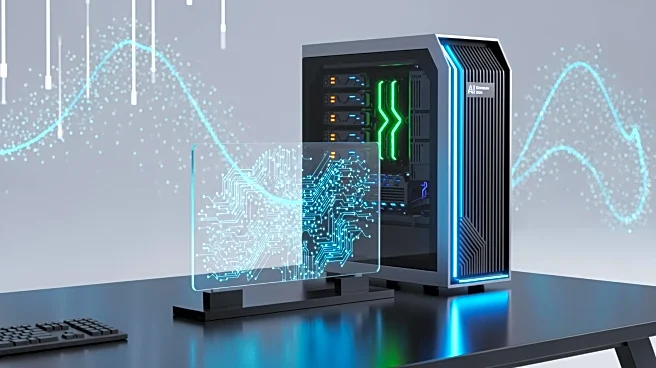
Supermicro has launched the Super AI Station, a new deskside AI supercomputer designed to bring data center-level performance to individual workspaces. This platform is built on NVIDIA's GB300 Grace Blackwell Ultra Superchip, providing a powerful and
secure environment for developing autonomous agents. The Super AI Station supports NVIDIA's AI software suite, including NemoClaw, allowing users to run complex, trillion-parameter models locally. This development aims to bridge the gap between consumer-grade workstations and data-center AI servers, offering a scalable and plug-and-play solution for enterprise AI needs.
Why It's Important?
The introduction of the Super AI Station is significant for enterprises seeking to enhance their AI capabilities without relying on external data centers. By enabling on-premises development of autonomous agents, companies can maintain greater control over their data, reducing privacy and security risks. This could lead to increased innovation in AI applications across various industries, as businesses can now leverage high-performance computing power directly at their desks. The move also reflects a growing trend towards decentralizing AI development, making advanced AI tools more accessible to a wider range of users.
What's Next?
As the Super AI Station becomes available, businesses are likely to explore its potential for various applications, from autonomous systems to complex data analysis. The platform's scalability and security features may attract interest from sectors such as finance, healthcare, and manufacturing, where data privacy is paramount. Additionally, the adoption of such technology could spur further advancements in AI software development, as more companies gain the capability to experiment with and deploy sophisticated AI models in-house.
Beyond the Headlines
The launch of the Super AI Station may also influence the competitive landscape of AI hardware providers. As more companies seek to integrate AI into their operations, the demand for powerful, yet accessible, AI development platforms is expected to rise. This could lead to increased competition among tech companies to offer innovative solutions that cater to the evolving needs of AI developers. Furthermore, the emphasis on local AI development could prompt discussions around data sovereignty and the ethical implications of AI deployment.