


What's Happening?
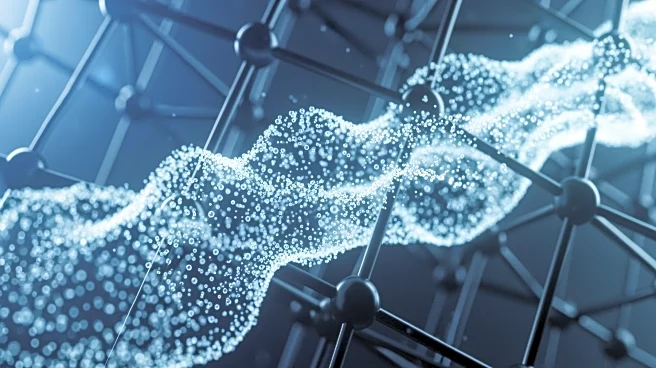
Researchers have developed a machine learning (ML) accelerated workflow that has successfully identified liquid-like ion flow in solid-state batteries (ASSB). This discovery is significant as it provides a new method to detect and predict rapid ion movement
through solid electrolytes, which is crucial for the performance of ASSBs. The ML approach combines force fields with tensorial models to simulate Raman spectra, revealing strong low-frequency Raman intensity as an indicator of liquid-like ionic conduction. This advancement allows for more accurate simulations of vibrational spectra at realistic temperatures, reducing computational costs and enabling high-throughput screening for new superionic materials.
Why It's Important?
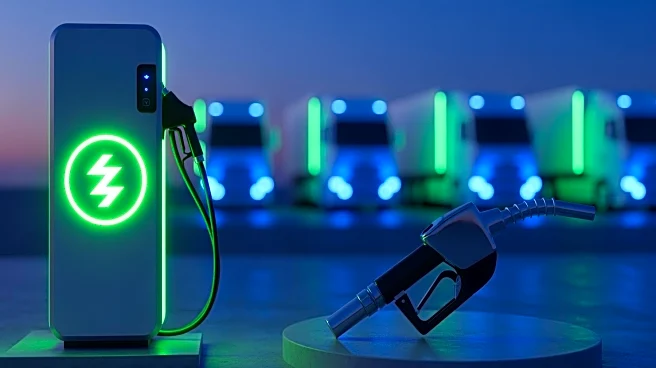
The ability to identify and predict liquid-like ion flow in solid-state batteries represents a major breakthrough in energy storage technology. Solid-state batteries are considered safer and more energy-dense alternatives to traditional lithium-ion batteries, and improving their performance could accelerate the development of high-performance battery technologies. This advancement has the potential to significantly impact the electric vehicle market and other industries reliant on efficient energy storage solutions. By enabling faster identification of suitable materials, the ML-accelerated approach could lead to more rapid advancements in battery technology, supporting the transition to cleaner energy sources.
What's Next?
The new ML-accelerated workflow is expected to facilitate further research into solid-state battery materials, potentially leading to the discovery of new superionic conductors. Researchers will likely continue to refine this approach, exploring its application to other classes of materials and expanding its use in energy storage research. The integration of AI in material science could drive innovation across various sectors, promoting the development of more efficient and sustainable technologies. As the demand for advanced battery solutions grows, this research could play a pivotal role in meeting future energy needs.