
What's Happening?
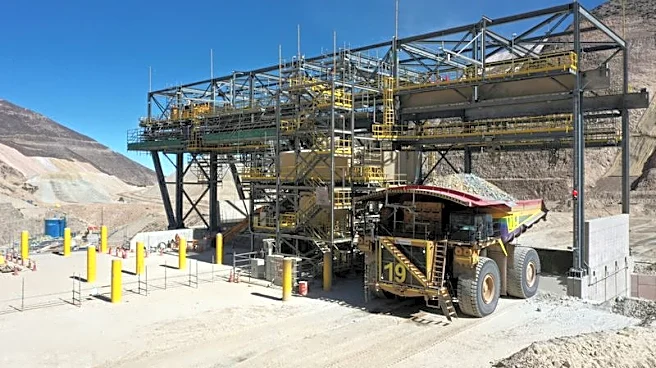
BHP, a diversified mining company, anticipates its full-year copper production to be in the upper half of its guidance range of 1.9 million to 2 million tonnes. This expectation is driven by robust production at the Escondida
mine in Chile and the Antamina mine in Peru, which have offset lower outputs at the Pampa Norte (Spence) mine in Chile. The company also maintains its full-year production guidance for iron ore, projecting between 258 million and 269 million tonnes, with the Samarco mine in Brazil expected to reach the upper end of its guidance. BHP's outgoing CEO, Mike Henry, highlighted the company's strong performance over the nine months ending March 31, including record material mined and concentrator throughput at Escondida and record production at its Western Australia Iron Ore operations. Despite a 3% year-on-year decrease in copper production to 1.46 million tonnes, BHP has made operational enhancements to improve recoveries and increase cathode production.
Why It's Important?
BHP's strong copper production outlook is significant as it underscores the company's resilience amid global economic pressures, including rising energy and consumable costs due to geopolitical tensions in the Middle East. Copper is a critical component in various industries, including electronics and renewable energy, making BHP's production levels crucial for meeting global demand. The company's ability to maintain and potentially exceed production targets could stabilize copper prices and supply chains, benefiting industries reliant on this metal. Additionally, BHP's performance in iron ore and coal production highlights its diversified portfolio's strength, which is vital for sustaining its market position and financial health.
What's Next?
BHP is expected to continue focusing on its copper growth program, emphasizing long-life, high-quality copper supply and disciplined capital allocation. The company is also testing new technologies, such as the Simple Approach to Leaching 2 (SaL2), to enhance processing capabilities at its mines. As BHP progresses deeper into the hypogene mineral areas, it will need to address challenges related to ore complexity and variability to maintain production efficiency. Stakeholders, including investors and industry partners, will likely monitor BHP's technological advancements and operational strategies closely, as these will influence future production capabilities and market dynamics.