


What's Happening?
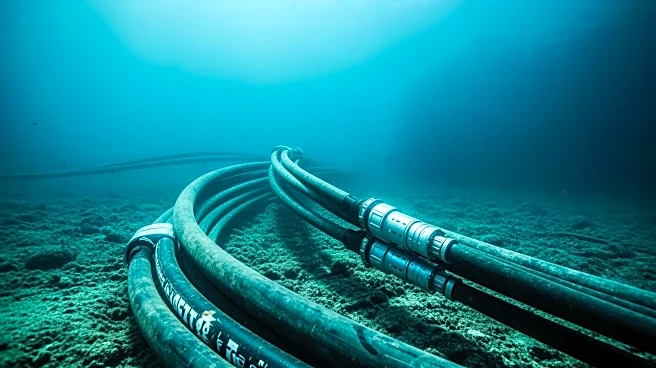
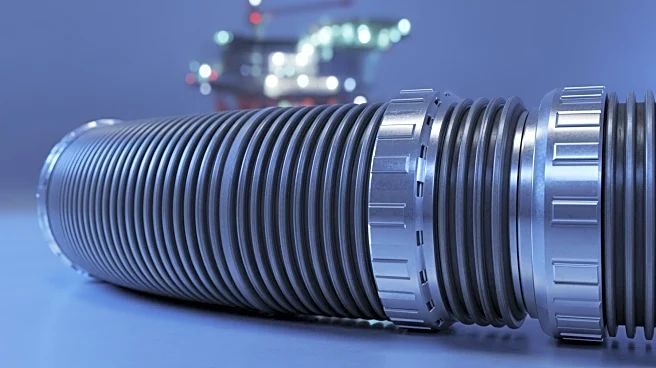
Recent discussions have highlighted the risks associated with High Voltage Direct Current (HVDC) export cables in offshore wind projects. While HVDC technology is essential for transmitting large amounts of power over long distances, especially as projects move
farther offshore, the cable systems themselves are not without risk. These cables, often treated as mere components of larger projects, can fail and lead to significant outages. The failure rate for subsea HVDC cables is estimated at 0.07 to 0.10 faults per 100 km-years, with repair times averaging 60 days. Such outages can result in substantial financial losses, as seen in the case of a 1 GW wind farm losing around 720 GWh of generation during a 60-day outage. The risks are compounded by manufacturing defects and installation challenges, which are more common than external factors like fishing or anchoring.
Why It's Important?
The significance of HVDC cable risks in offshore wind projects lies in their potential impact on energy reliability and financial performance. As offshore wind farms become larger and more distant from shore, the reliance on HVDC technology increases. However, the high-consequence nature of cable failures means that even infrequent events can lead to substantial generation losses and financial repercussions. This underscores the need for developers and policymakers to treat HVDC systems as critical infrastructure, requiring careful planning and risk management. The energy transition towards renewable sources like offshore wind is crucial for meeting decarbonization goals, but the reliability of transmission systems is equally important to ensure consistent power supply and economic viability.
What's Next?
Developers and policymakers are encouraged to adopt a more rigorous approach to managing HVDC cable risks. This includes separating risk assessments for wind farms and export systems, investing in better seabed surveys, burial designs, and interface engineering, and ensuring repair readiness before project commissioning. Additionally, sharing more data on cable performance and failures can improve risk forecasting and policy design. As offshore wind projects continue to expand, understanding and mitigating the risks associated with HVDC cables will be essential for achieving energy security and sustainability goals.
Beyond the Headlines
The broader implications of HVDC cable risks extend to energy policy and infrastructure planning. As countries increasingly rely on offshore wind to meet renewable energy targets, the reliability of transmission systems becomes a matter of national interest. The concentration of generation behind HVDC circuits means that failures can have widespread impacts on power systems. Therefore, strategic decisions about redundancy, phasing, and insurance are necessary to mitigate these risks. The energy transition is not just about deploying mature technologies but also about ensuring their robust integration into existing systems.