





What's Happening?
General Motors (GM) is investing $340 million in its U.S. plants to boost production of gas-powered vehicle components. This decision comes in response to a nationwide slowdown in demand for electric vehicles (EVs). The investment will be directed towards
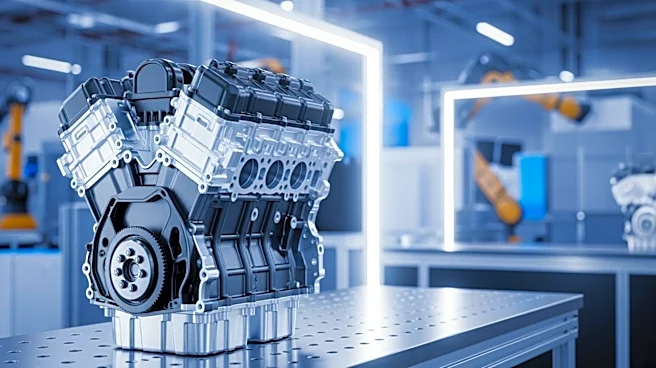
two propulsion facilities in Romulus, Michigan, and Toledo, Ohio, which produce key parts for internal combustion engine vehicles, such as 10-speed transmissions and engine components. The Romulus plant will receive $300 million, while the Toledo plant will get an additional $40 million. GM has invested over $6 billion in its U.S. manufacturing in the past year. The company aims to increase production of its high-profit trucks, SUVs, and the Chevrolet Corvette, which continue to drive significant profits. This move is part of GM's recalibration of production plans as EV sales have slowed, with recent data showing sharp declines in sales of several electric models.
Why It's Important?
The investment by GM highlights the shifting dynamics in the automotive industry, where the anticipated rapid adoption of EVs has not materialized as expected. This decision underscores the importance of gas-powered vehicles in GM's portfolio, which remain profitable and in demand. The slowdown in EV sales is partly attributed to the cancellation of the federal government's $7,500 tax credit for U.S.-built EVs, affecting consumer incentives. GM's strategy reflects a broader industry trend where automakers are balancing investments in EVs with continued production of traditional vehicles to meet consumer preferences. This move could impact the U.S. automotive market by reinforcing the presence of gas-powered vehicles, while also influencing the pace of EV adoption and infrastructure development.
What's Next?
GM plans to continue investing in its workforce and facilities to support increased production capacity for gas-powered vehicles. The company is also focused on improving EV profitability and scaling its business as market adoption grows, albeit at a slower pace than previously anticipated. GM's investment strategy may prompt other automakers to reassess their production plans and investment priorities in response to evolving consumer demand and competitive pressures. The automotive industry may see further adjustments in production strategies as companies navigate the balance between traditional and electric vehicle offerings.