
What's Happening?
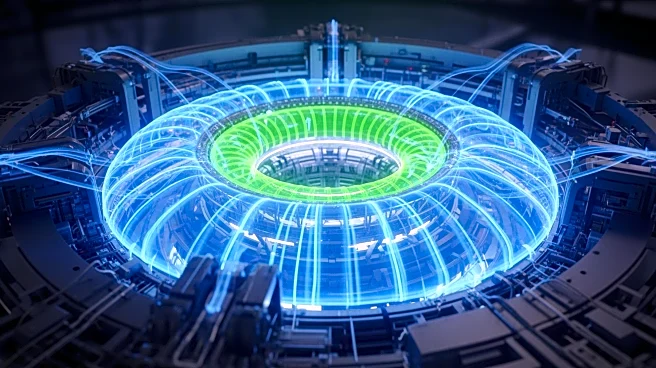
Physicists at the Experimental Advanced Superconducting Tokamak (EAST) in China have successfully exceeded the Greenwald limit, a previously accepted density boundary for plasma in fusion reactors. This
breakthrough was achieved by precisely controlling the plasma's interaction with reactor walls, allowing for a 'density-free' regime. The Greenwald limit has long been a challenge in fusion reactor engineering, as exceeding it typically leads to destabilization and potential damage to reactor components. By adjusting the pressure of the fuel gas and employing electron cyclotron resonance heating during startup, researchers reduced wall impurities entering the plasma, thus maintaining stability at higher densities. This experiment demonstrated the possibility of operating fusion reactors at densities 65% higher than the traditional limit, suggesting that the Greenwald limit is not an insurmountable barrier.
Why It's Important?
This development is significant for the future of energy production, as it addresses one of the major hurdles in achieving efficient nuclear fusion. Fusion reactors aim to replicate the energy generation process of the sun, offering a potentially limitless and clean energy source. Overcoming the Greenwald limit could lead to more effective and sustainable fusion reactors, reducing reliance on fossil fuels and contributing to global energy security. The ability to operate at higher plasma densities could increase energy output, making fusion a more viable alternative to current energy sources. This advancement could have profound implications for industries and economies worldwide, particularly in the U.S., where energy independence and sustainability are critical policy goals.
What's Next?
The research team plans to continue experimenting with the new density-free regime to further understand its potential under high-performance conditions. These findings could inform the design and operation of next-generation fusion devices, potentially leading to scalable and practical solutions for extending density limits in tokamaks. As the research progresses, it may attract interest from international energy agencies and private sector stakeholders looking to invest in fusion technology. The success of these experiments could accelerate the timeline for commercial fusion energy, influencing energy policy and investment strategies globally.