
What's Happening?
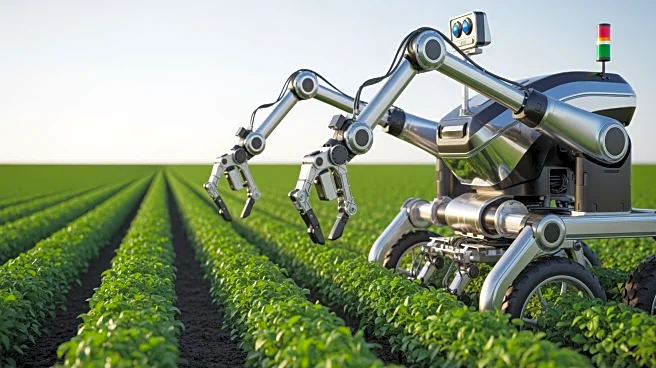
Kilter AS, a company based in Langhus, Norway, has introduced the AX-1, an autonomous robot designed to transform weed management in vegetable production. The AX-1 employs machine learning to identify
and target individual weeds, significantly reducing the use of herbicides by up to 95%. This precision approach contrasts with traditional blanket spraying methods that treat entire fields regardless of weed density. The AX-1 is capable of operating 24/7, providing a consistent workforce for both conventional and organic farming operations. It is designed to improve crop yield by reducing competition and avoiding growth delays associated with broad-spectrum chemical applications. The robot's lightweight design prevents soil compaction, allowing it to operate on soft soils shortly after rain.
Why It's Important?
The introduction of the AX-1 robot is significant for the agricultural industry as it addresses key challenges such as labor costs, chemical regulations, and environmental sustainability. By reducing herbicide usage, the AX-1 not only lowers chemical costs for farmers but also minimizes environmental impact, aligning with increasing regulatory pressures and consumer demand for sustainable farming practices. The robot's ability to operate autonomously around the clock offers a solution to labor shortages, particularly in organic farming where manual weeding is labor-intensive. This innovation represents a shift towards data-driven, precision agriculture, potentially setting a new standard for weed management and crop production efficiency.
What's Next?
As Kilter encourages growers to adopt this autonomous, data-driven approach, the agricultural sector may see a gradual transition from traditional practices to more sustainable methods. The success of the AX-1 could lead to broader adoption of similar technologies, prompting further innovations in precision agriculture. Stakeholders, including farmers, environmental groups, and regulatory bodies, may closely monitor the AX-1's performance and its impact on crop yields and environmental sustainability. Future developments could include enhancements in detection technology and the expansion of compatible bio-herbicides, further reducing the ecological footprint of farming operations.