
What's Happening?
Astrobotic, a Pittsburgh-based company, has successfully completed a series of hot-fire tests of its rotating detonation rocket engine (RDRE) prototype, Chakram. This marks a significant milestone in the
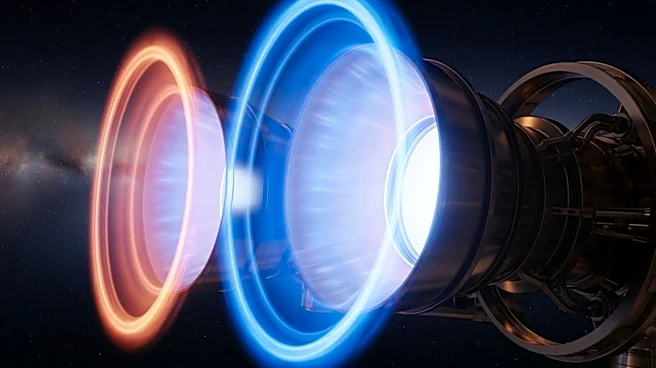
development of this experimental propulsion technology. Unlike conventional rocket engines, RDREs utilize a continuous, circular detonation wave within a ring-shaped chamber, which enhances pressure and efficiency, resulting in increased thrust with less fuel. The tests, conducted at NASA's Marshall Space Flight Center, demonstrated the engine's ability to operate continuously, achieving a 300-second burn, the longest for an RDRE to date. The tests showed no visible damage to the hardware, indicating the engine's potential reliability for future space missions.
Why It's Important?
The successful testing of the RDRE prototype by Astrobotic represents a potential breakthrough in space propulsion technology. The increased efficiency and reduced size and weight of RDREs could significantly impact spacecraft design and mission planning, particularly for deep space exploration. This advancement could lead to more cost-effective and efficient space missions, enhancing the capabilities of lunar landers and orbital transfer vehicles. The development of such technology is crucial for expanding operations in cislunar space and beyond, potentially supporting future missions to the moon and other celestial bodies.
What's Next?
Astrobotic plans to continue refining the RDRE technology, focusing on improvements in engine throttling, regenerative cooling, and mass reduction. The company aims to transition the engine from testing to flight-ready hardware, potentially integrating it into future versions of its Griffin lunar lander and other spacecraft. The ongoing development is supported by NASA's Small Business Innovation Research contracts and a Space Act Agreement, highlighting the collaborative efforts to advance space propulsion technology.