


What's Happening?
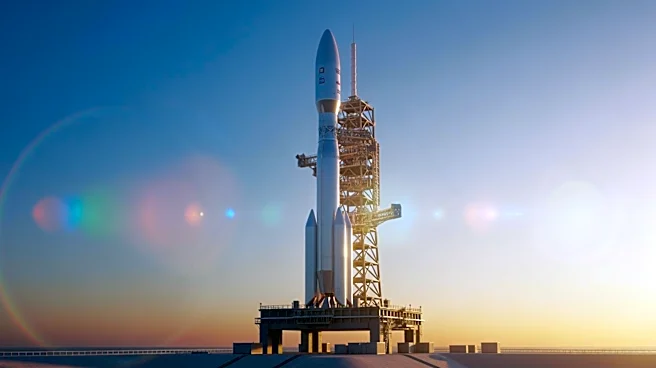
The United Launch Alliance (ULA) Atlas V rocket is set to launch its heaviest payload to date on April 4, 2026, from Florida's Cape Canaveral Space Force Station. The mission, designated LA-05, will carry 29 satellites for Amazon's Leo broadband constellation,
previously known as Project Kuiper. This launch marks a significant step in Amazon's plan to deploy approximately 3,200 satellites in low Earth orbit, aiming to provide global internet coverage. The payload, weighing 18 tons, is the largest ever flown on an Atlas V rocket, facilitated by a new, higher-performing version of the RL10C engine on the rocket's Centaur upper stage. Amazon's Leo constellation is in its early stages, with 212 satellites already in orbit from previous launches, including missions utilizing SpaceX's Falcon 9 and Arianespace's Ariane 6 rockets.
Why It's Important?
The launch of Amazon's Leo satellites is a critical development in the race to provide global internet coverage through satellite constellations. Amazon's initiative is a direct competitor to SpaceX's Starlink network, which already has over 10,000 satellites in orbit. The successful deployment of Amazon's satellites could significantly impact the telecommunications industry by increasing internet accessibility worldwide, particularly in remote and underserved areas. This competition between major tech companies like Amazon and SpaceX could drive innovation and lower costs for consumers. Additionally, the deployment of such large satellite constellations raises concerns about space traffic management and collision risks, necessitating careful coordination and regulation.
What's Next?
Following the LA-05 mission, Amazon plans to continue launching satellites to complete its Leo constellation. Future launches will likely involve collaborations with various rocket providers, including ULA, SpaceX, and Arianespace. As the constellation grows, Amazon will need to address regulatory challenges and ensure safe operations in increasingly crowded orbital environments. The company may also explore partnerships with telecommunications providers to expand its internet services globally. Stakeholders, including government agencies and industry competitors, will closely monitor Amazon's progress and its impact on the satellite internet market.
Beyond the Headlines
The expansion of satellite internet services by companies like Amazon and SpaceX could have long-term implications for global connectivity and digital equity. By providing internet access to remote regions, these initiatives could support economic development, education, and healthcare improvements. However, the proliferation of satellites also raises ethical and environmental concerns, such as the potential for increased space debris and its impact on astronomical observations. As satellite constellations become more prevalent, there will be a growing need for international cooperation and regulation to address these challenges.