







What's Happening?
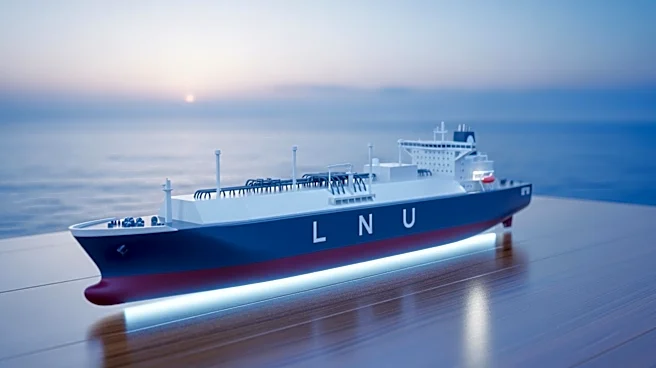
Taiwanese shipping company U-Ming has announced the naming of its first LNG carrier, marking a significant step in its business growth and diversification strategy. The vessel, named Diamond Gas Jade, was unveiled at a ceremony on May 19 at Samsung Heavy
Industries' Geoje Shipyard in South Korea. This new addition to U-Ming's fleet is part of the company's entry into the energy transport sector, complementing its existing operations with Very Large Crude Carriers. The Diamond Gas Jade boasts a capacity of 174,000 cubic meters of LNG and features advanced energy-saving technologies, including a dual-fuel ME-GA propulsion system. U-Ming plans to launch a joint venture to expand its operations into LNG transport upon the ship's delivery in August.
Why It's Important?
U-Ming's expansion into the LNG transport sector is a strategic move that aligns with global trends towards cleaner energy sources. By diversifying its fleet to include LNG carriers, U-Ming is positioning itself to capitalize on the growing demand for LNG as a cleaner alternative to traditional fossil fuels. This move not only enhances U-Ming's competitive edge in the maritime industry but also supports global efforts to reduce carbon emissions. The company's commitment to expanding its fleet and incorporating alternative energy solutions, such as wind rotors on bulk carriers, reflects a broader industry shift towards sustainability and innovation.
What's Next?
Following the delivery of the Diamond Gas Jade, U-Ming will focus on establishing a joint venture to facilitate its entry into the international LNG transport market. The company is also pursuing a 'dual growth' strategy, aiming to exceed 100 vessels and a total deadweight tonnage of over 10 million tons. This includes the construction of additional Capesize and Ultramax bulk carriers. As U-Ming continues to expand its fleet and diversify its operations, it is likely to explore further opportunities in alternative energy sectors, potentially influencing other maritime companies to adopt similar strategies.