

What's Happening?
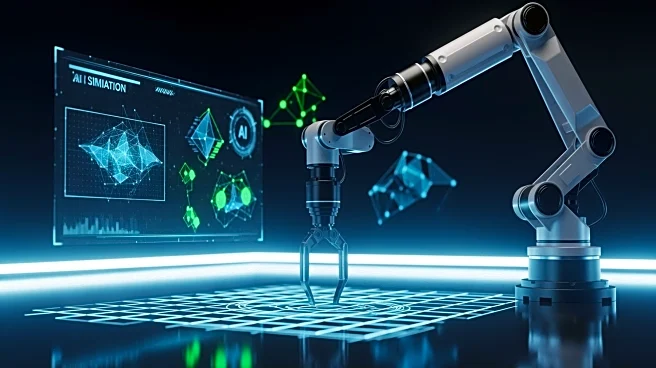
Rhoda AI has emerged from stealth mode, announcing a significant $450 million Series A funding round aimed at advancing robotic intelligence through video-predictive control. The company introduced its FutureVision approach, which leverages internet-scale
video to train robots to adapt to real-world environments. This method contrasts with traditional industrial robots that operate on pre-programmed trajectories and struggle with real-world variability. Rhoda's technology combines extensive video pretraining with closed-loop video predictive control, allowing robots to autonomously adapt and operate in dynamic settings. The company collaborates with industrial partners in manufacturing and logistics to implement its technology.
Why It's Important?
The development of Rhoda AI's technology represents a significant advancement in the field of robotics, particularly in enhancing the adaptability and autonomy of robots in real-world environments. This innovation could transform industries reliant on robotics, such as manufacturing and logistics, by improving efficiency and reducing the need for human intervention. The substantial investment from prominent technology investors underscores the potential impact of Rhoda's approach on the robotics industry. By enabling robots to learn from vast amounts of video data, Rhoda aims to overcome the limitations of current AI models, which often struggle with unpredictable real-world conditions.
What's Next?
With the $450 million funding, Rhoda AI plans to continue its research and engineering efforts, expand industrial deployments, and conduct customer pilots. The company aims to grow its multidisciplinary team, focusing on generative AI, computer vision, and robotics. As Rhoda's technology gains traction, it is expected to be licensed to partners across various robotic hardware and software platforms, potentially leading to widespread adoption in different sectors. The success of Rhoda's approach could prompt other companies to explore similar video-based training methods, further advancing the capabilities of autonomous robots.