




What's Happening?
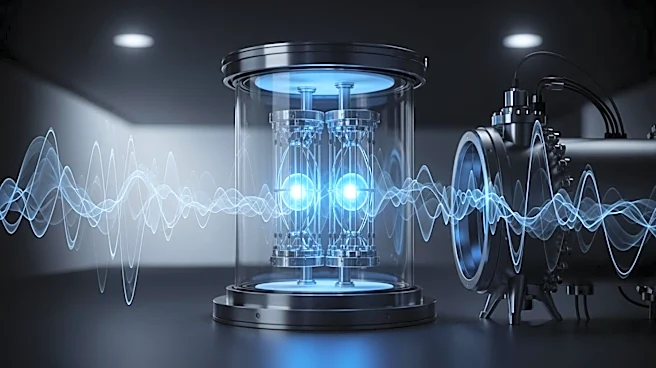
Researchers have developed a new compact detector that utilizes quantum physics and a specially engineered metasurface to enhance terahertz radiation detection. This innovation addresses the challenges of detecting terahertz frequencies, which lie between
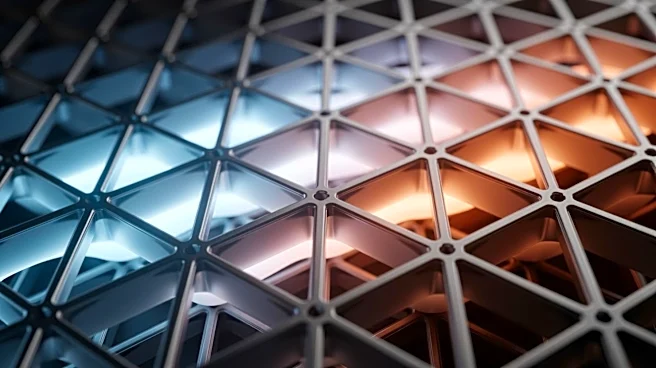
microwaves and infrared light. The device employs the in-plane photoelectric effect, where terahertz photons energize electrons within a two-dimensional electron gas, creating an electrical current. The metasurface, designed with a 'brickwork' pattern, concentrates electromagnetic energy into small regions, improving detection efficiency. This approach eliminates the need for external optics and complex detector arrays, simplifying the manufacturing process and potentially enabling large-scale production.
Why It's Important?
The development of this quantum metasurface detector represents a significant advancement in terahertz technology, which has applications in wireless networks, healthcare, astronomy, and quality assurance in manufacturing. By improving detection efficiency and simplifying the manufacturing process, this innovation could lead to more widespread adoption of terahertz technology. The ability to operate at higher temperatures than existing detectors further enhances its practical applications, bridging the gap between cryogenic and room-temperature devices. This breakthrough could unlock new possibilities in various fields, driving technological progress and economic growth.
What's Next?
The researchers plan to explore the scalability of the detector design across different frequencies, from microwave to mid-infrared wavelengths. This could expand the range of applications and further integrate the technology into existing electronic systems. The team also aims to optimize the structural features of the detector to enhance its performance and explore potential commercial applications. As the technology matures, it may attract interest from industries seeking to leverage terahertz technology for innovative solutions.