






What's Happening?
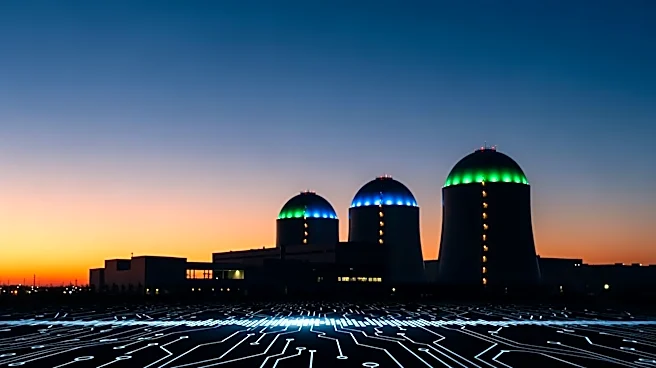
Major technology companies are investing in next-generation nuclear power technologies to meet the increasing energy demands of AI data centers. Companies like Meta, Amazon, and Google are entering agreements with nuclear firms to develop modular reactors
that promise scalable and advanced solutions. These reactors are smaller and more efficient than traditional nuclear plants, but face challenges such as financing and construction risks. Meta has partnered with Terrapower and Oklo, while Amazon collaborates with X-energy, and Google with Kairos Power. These partnerships aim to provide substantial power outputs, with projects expected to come online by 2030 and beyond.
Why It's Important?
The involvement of tech giants in nuclear energy marks a significant shift in the funding landscape, providing financial stability and revenue certainty that can attract commercial banks to the sector. This is crucial as the demand for electricity is projected to rise due to AI data center needs. The modular reactors offer a more financeable alternative due to their reduced upfront capital requirements and shorter construction timelines. However, the industry still faces hurdles such as high construction costs and technology risks, which could impede large-scale deployment despite the growing interest from institutional investors.
What's Next?
The nuclear sector must overcome several challenges to achieve commercialization and large-scale deployment. These include securing licensing, fuel supply, and financing, as well as addressing a looming skills shortage in the workforce. The success of these projects will depend on the willingness of tech companies to assume risks associated with cost overruns and delays. Long-term agreements with power buyers are crucial for project development, and the interest from banks in deal-making could be a pivotal development for the industry.