







What's Happening?
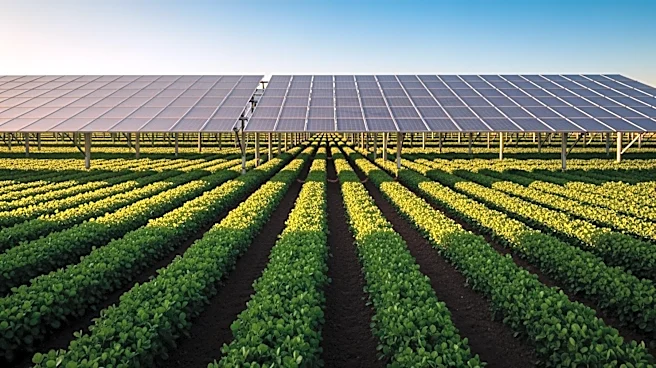
Agrivoltaics, the practice of integrating solar panels with agricultural activities, is gaining attention for its potential to improve crop performance and reduce environmental stress. This approach involves various configurations, such as growing vegetables
under elevated solar panels, grazing sheep beneath solar arrays, and using solar canopies over orchards. The concept is particularly effective in hot, dry regions where crops suffer from excessive heat and water scarcity. By providing partial shade, solar panels can reduce water stress, lower evaporation rates, and cool the microclimate, which can enhance both crop yield and solar panel efficiency. While China leads globally in agrivoltaic capacity, the United States is actively participating through research and demonstration projects, focusing on sheep grazing and pollinator habitats.
Why It's Important?
The integration of solar panels with farming practices offers a dual benefit of generating renewable energy while supporting agricultural productivity. This approach can help mitigate the impacts of climate change by reducing water usage and protecting crops from heat stress. For farmers, agrivoltaics presents an opportunity to diversify income streams and reduce operational costs, such as mowing and irrigation. The practice also aligns with sustainable development goals by promoting clean energy and enhancing food security. However, successful implementation requires careful planning to ensure that agricultural activities are not compromised and that the economic benefits are equitably distributed between solar developers and farmers.
What's Next?
As agrivoltaics continues to gain traction, further research and field trials are expected to refine the technology and optimize its application across different agricultural systems. Policymakers may need to establish clear guidelines and incentives to encourage the adoption of agrivoltaics while ensuring that agricultural productivity is maintained. The development of standardized metrics to evaluate the effectiveness of agrivoltaic systems will be crucial in assessing their impact on crop yield, water usage, and energy production. Additionally, collaboration between solar developers, farmers, and government agencies will be essential to address potential challenges and maximize the benefits of this innovative approach.
Beyond the Headlines
The broader implications of agrivoltaics extend beyond immediate agricultural and energy benefits. By integrating renewable energy with farming, agrivoltaics can contribute to rural development and resilience against climate change. It also presents an opportunity to rethink land use and resource management, promoting a more holistic approach to sustainability. However, the success of agrivoltaics depends on addressing potential pitfalls, such as ensuring that agricultural activities remain economically viable and that the technology does not become a mere tool for land control by solar developers. Transparent policies and active farmer participation will be key to realizing the full potential of agrivoltaics.