



What's Happening?
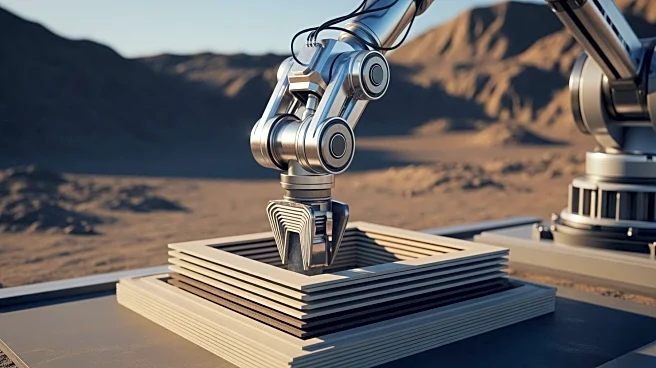
Recent research published in npj Space Exploration highlights the transformative potential of robotic prefabrication and three-dimensional (3D) printing in constructing buildings in extreme environments, including potential habitats on Mars. The study
analyzed architectural and environmental data from various construction projects, focusing on the efficiency and sustainability of automated construction technologies. These technologies, which include robotic systems and additive manufacturing, promise to enhance building efficiency, reduce material waste, and support the development of resilient structures. The research also explored the use of local materials, such as Martian regolith, for construction, which could significantly reduce the need for transporting materials from Earth. The study's findings suggest that these technologies could be crucial for developing durable habitats capable of withstanding harsh conditions on Mars and other extreme environments on Earth.
Why It's Important?
The implications of this research are significant for both terrestrial and extraterrestrial construction. On Earth, robotic prefabrication and 3D printing could improve construction efficiency in remote or resource-constrained environments, such as Arctic regions and deserts, by reducing material waste and labor requirements. This could also facilitate rapid infrastructure deployment in disaster relief operations. In space, these technologies could enable the construction of habitats using local materials, reducing the logistical challenges of transporting building materials from Earth. The study also highlights the potential for significant reductions in embodied carbon emissions, particularly in high-latitude regions, through prefabrication efficiencies and improved construction logistics. This research underscores the growing global investment in automated construction technologies, with many companies in Europe, China, and North America leading the way.
What's Next?
Future research is likely to focus on enhancing automated construction systems, developing new printable materials, and integrating critical habitat systems such as radiation protection and life-support technologies. The study also calls for increased collaboration across disciplines like robotics, materials science, and architecture to develop fully integrated extraterrestrial habitat systems. As the field of automated construction continues to expand, these technologies could play a pivotal role in supporting sustainable construction practices and enabling human missions beyond Earth.