
What's Happening?
CryoBio, a New York-based company, has raised $1.3 million in a pre-seed funding round to develop a novel frost protection solution for high-value crops like apples and grapes. The funding will be used
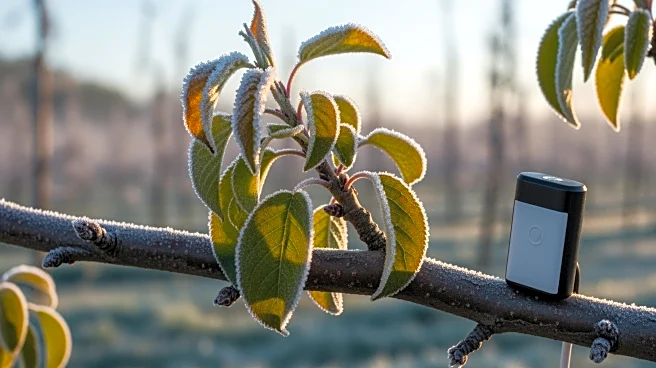
to expand operations and hire additional staff in biochemical engineering, biomanufacturing, and horticulture. Frost poses a significant threat to farmers, exacerbated by climate change, with warmer winters and earlier springs making crops more vulnerable to late cold snaps. Traditional frost protection methods, such as candles and insulation blankets, are considered outdated and expensive. CryoBio's approach involves using antifreeze proteins inspired by animals that survive in subzero temperatures. These proteins are produced in a fermentation tank, extracted, and supplied to farmers as a powder to be sprayed on crops before frost events. The company is preparing for field trials in New York, Washington, and Canada.
Why It's Important?
The development of effective frost protection is crucial for the agricultural industry, particularly as climate change increases the frequency and severity of frost events. In 2024 alone, frost and freeze events caused $854 million in U.S. crop losses, with potential losses reaching up to $3 billion in severe years. CryoBio's innovative solution could provide a more reliable and cost-effective method for protecting crops, reducing financial losses for farmers and ensuring food security. By leveraging biotechnology, CryoBio aims to offer a modern alternative to traditional methods, potentially transforming agricultural practices and enhancing crop resilience.
What's Next?
CryoBio plans to conduct extensive field trials to validate its technology and refine the product formulation. The company aims to scale up production and achieve regulatory approval, focusing on state-level registration to expedite market entry. If successful, CryoBio's solution could be available to growers in New York by 2027. The company is also exploring international markets, considering regulatory pathways in regions like New Zealand, Australia, and Europe. As CryoBio advances its technology, it may face challenges related to scaling production and navigating regulatory landscapes, particularly if it involves genetically modified organisms.