







What's Happening?
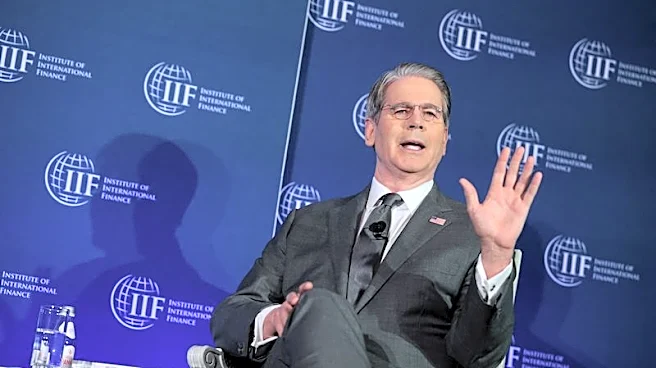
US Treasury Secretary Scott Bessent has emphasized the importance of energy security and the expansion of critical minerals investment during meetings with the International Monetary Fund (IMF) and World Bank in Washington DC. Bessent advocates for an 'all-of-the-above'
energy approach, including fossil fuels, to ensure economic security and technological leadership. He argues that the World Bank's climate-focused targets hinder market efficiency and economic growth, suggesting a shift towards supporting projects that lift people out of poverty. Bessent also calls for financing to support mining deals and infrastructure development to diversify supply chains, reducing reliance on single-source suppliers and mitigating geopolitical risks.
Why It's Important?
Bessent's statements highlight a significant policy direction for the US, prioritizing energy abundance as a foundation for economic resilience. By supporting fossil fuels alongside critical minerals, the US aims to secure steady access to resources essential for advanced technologies. This approach could impact global energy markets and influence international economic policies, as the US seeks to strengthen its position in critical minerals supply chains. The focus on energy security over climate targets may also affect international climate agreements and the global transition to green energy, potentially leading to geopolitical shifts and economic realignments.
What's Next?
The US government's stance may prompt reactions from international stakeholders, including environmental groups and countries committed to climate goals. The World Bank and other international institutions might face pressure to adjust their policies to align with the US's emphasis on energy security. Additionally, businesses involved in mining and energy sectors could see increased investment opportunities, while those focused on renewable energy might need to adapt to changing priorities. The US's approach could also influence other nations to reconsider their energy and economic strategies, potentially leading to broader shifts in global energy policies.