



What's Happening?
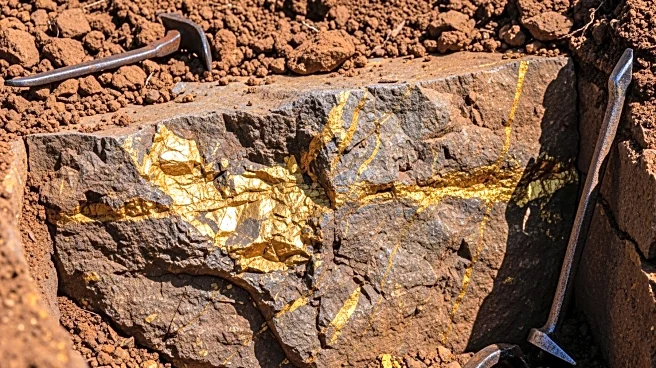
Collective Mining Ltd. has announced significant assay results from its drilling operations at the Ramp Zone, part of the Apollo system in Caldas, Colombia. The company reported a high-grade intercept of 58.10 meters at 21.33 grams per tonne (g/t) gold, including a section of 27.00 meters at 43.13 g/t gold. This marks the highest-grade and deepest intercept to date at the site. The drilling has expanded the mineralized envelope to 300 meters of strike by 100 meters in width and 310 meters vertically, with the zone remaining open in all directions. The Apollo system is a large, partially reduced intrusion-related system enriched in gold, silver, copper, and tungsten, and is part of the company's flagship Guayabales Project.
Why It's Important?
The expansion of the
Ramp Zone with high-grade gold intercepts underscores the potential of the Apollo system to become a major mining project in Colombia. This development is significant for Collective Mining as it positions the company to capitalize on the growing demand for gold and other critical minerals like copper and tungsten. The project's location in a mining-friendly region with established infrastructure enhances its viability. The results also highlight the potential for further discoveries, which could increase the project's value and attract more investment. As the company accelerates its drilling program, it aims to transform Apollo into a producing mine, contributing to Colombia's economy and the global supply of essential minerals.
What's Next?
Collective Mining plans to continue its aggressive drilling program with three deep-capacity diamond rigs currently operating at the Ramp Zone. The company anticipates the arrival of two additional rigs in the first quarter of 2026. With a fully funded 2026 program, Collective aims to conduct up to 100,000 meters of additional drilling across its projects. The company is focused on expanding the Ramp Zone and exploring new targets within the Guayabales Project. As drilling progresses, the company expects to release further assay results, which could provide additional insights into the project's potential and guide future development plans.