
What's Happening?
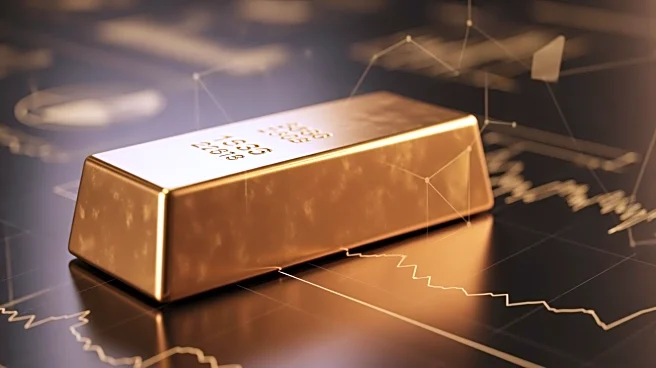
HSBC has forecasted that gold prices could rise to $5,000 an ounce in the first half of 2026, driven by geopolitical risks and increasing global debt. Despite this optimistic projection, the bank has slightly
lowered its average price forecast for 2026 to $4,587 an ounce, down from $4,600, due to potential market corrections. These corrections could occur if geopolitical tensions ease or if the U.S. Federal Reserve halts its interest rate cuts. HSBC anticipates a volatile trading environment, with gold prices ranging between $3,950 and $5,050 per ounce throughout the year. The bank has also adjusted its forecasts for 2027 and 2028, predicting higher average prices than previously expected.
Why It's Important?
The potential rise in gold prices reflects broader economic uncertainties and the role of gold as a safe-haven asset during times of geopolitical instability and financial uncertainty. For investors, this presents an opportunity to hedge against market volatility and currency fluctuations. The forecasted increase in gold prices could also impact industries reliant on gold, such as jewelry and electronics, potentially leading to higher costs for consumers. Additionally, central banks and financial institutions may adjust their strategies in response to these price movements, influencing global economic policies and investment trends.
What's Next?
Investors and market analysts will closely monitor geopolitical developments and monetary policy decisions by major central banks, particularly the U.S. Federal Reserve, as these factors will significantly influence gold prices. Should geopolitical tensions escalate or economic conditions worsen, demand for gold could increase further, driving prices higher. Conversely, stabilization in these areas could lead to a market correction. Stakeholders in the gold market, including miners and traders, will need to adapt to these potential fluctuations to optimize their strategies and mitigate risks.