
What's Happening?
The global agriculture analytics market is expected to grow significantly, reaching USD 7.50 billion by 2032, with a compound annual growth rate (CAGR) of 14.49% from 2025 to 2032. This growth is driven
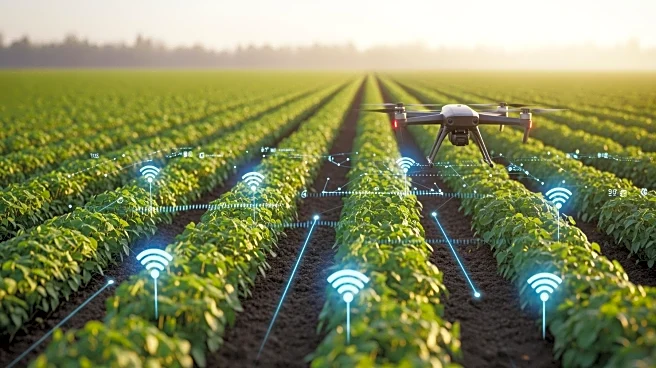
by the increasing adoption of advanced technologies such as artificial intelligence (AI), the Internet of Things (IoT), and big data in farming operations. These technologies enable precision agriculture by providing real-time insights into crop health, soil quality, and irrigation efficiency, allowing farmers to make data-driven decisions. The market is dominated by solutions that integrate AI and IoT for precision farming, accounting for 60% of the market share. North America leads the market with a 38% share, supported by strong government initiatives and investments in agritech startups.
Why It's Important?
The expansion of the agriculture analytics market is crucial for meeting the growing global food demand, which is expected to rise significantly as the world population approaches 9.8 billion by 2050. By leveraging data-driven solutions, farmers can optimize resource utilization, improve yields, and reduce waste, contributing to sustainable agricultural practices. The adoption of these technologies is particularly important in regions like North America and Europe, where large-scale commercial farms are prevalent. Additionally, the integration of AI and IoT in agriculture supports global sustainability goals by enabling efficient water and nutrient management, which are critical for reducing environmental impact and ensuring food security.
What's Next?
As the agriculture analytics market continues to grow, further advancements in AI and IoT technologies are expected to enhance the capabilities of precision farming solutions. The development of affordable cloud-based analytics platforms will likely lower the barriers to entry for small and medium-sized farms, facilitating wider adoption of data-driven farming practices. Additionally, ongoing mergers and acquisitions in the agritech sector are expected to expand the range of analytics offerings, providing farmers with more comprehensive tools for managing crop and livestock operations. Government initiatives and investments in smart farming technologies will continue to play a significant role in driving market growth.