





What's Happening?
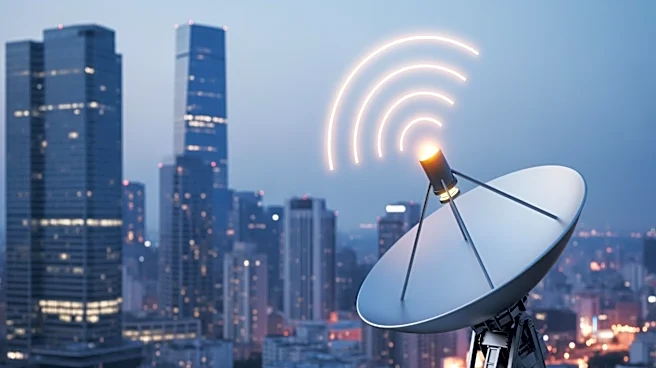
NTT Docomo Business has upgraded its mobile global navigation satellite system (GNSS) positioning service to improve accuracy in urban areas where satellite signals are often disrupted. The enhancement involves integrating satellite signals with a nine-axis
sensor, which calculates attitude, heading, and angular velocity, thereby reducing disturbances in positioning accuracy. This service, initially launched in 2023, previously relied on real-time kinematic (RTK) technology, which uses correction data from ground stations to enhance satellite data accuracy. The upgraded service now includes a new receiver that combines RTK data with the nine-axis sensor information, doubling the battery life of previous models and incorporating an LTE module for better positioning data. Additionally, the switch from an eSIM to a physical nano SIM allows the technology to be used in drones, expanding its application potential.
Why It's Important?
The upgrade of NTT Docomo's GNSS service is significant as it addresses the challenges of positioning accuracy in densely populated urban environments, which are critical for various industries. The enhanced service is particularly beneficial for sectors such as construction, railways, broadcasting, and public utilities, where precise positioning is crucial. It also supports the development of autonomous vehicles and smart city infrastructure, which rely on accurate location data. By improving positioning accuracy, the service can facilitate more efficient operations and innovation in these fields, potentially leading to economic benefits and advancements in urban planning and management.
What's Next?
As NTT Docomo Business continues to evolve its GNSS technology, it anticipates broader adoption across various industries. The company has already demonstrated the service's capabilities by partnering with TBS Television to track participants in a mini-marathon event. Future developments may include further enhancements to the technology's accuracy and battery life, as well as expanded use cases in new sectors. Stakeholders in industries such as transportation, logistics, and urban development may increasingly rely on this technology to improve operational efficiency and support new applications.