

What's Happening?
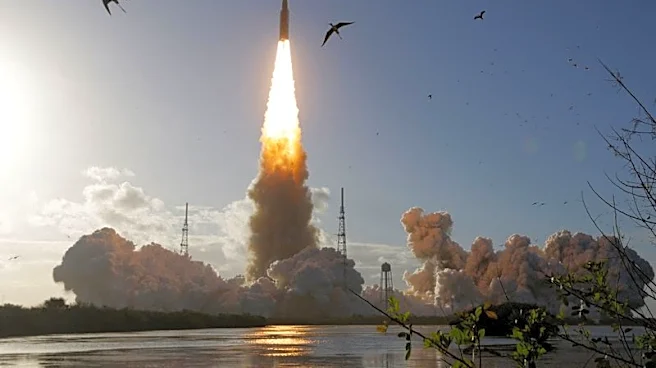
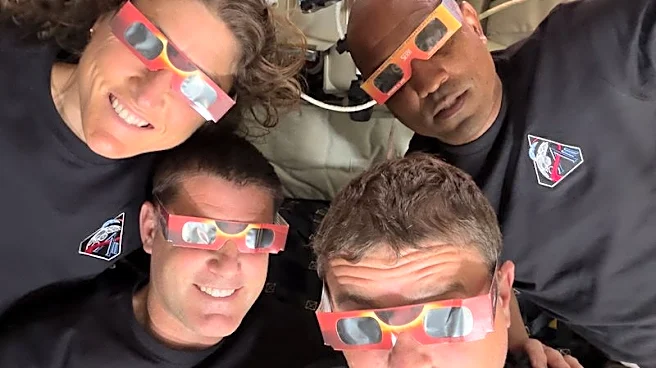
The Artemis II mission, marking the first manned flight around the Moon in several decades, has reignited interest in the Kerbal Space Program, a realistic space program simulator video game. The mission, which involved four astronauts, has captivated
public attention, leading to a surge in the game's popularity. On April 1, 2026, coinciding with the Artemis II launch, the number of players on the Kerbal Space Program peaked at 12,434, a significant increase from its usual 3,000 to 4,000 players. The game, known for its realistic depiction of space physics, allows players to build and launch rockets, simulating real-world space missions. Despite being released in 2015, the game remains a cultural phenomenon among space enthusiasts and is used as an educational tool to teach the basics of space travel.
Why It's Important?
The renewed interest in the Kerbal Space Program highlights the public's fascination with space exploration and its potential as an educational tool. The game's realistic physics engine provides a platform for users to understand complex space dynamics, making it a valuable resource for both educational institutions and space enthusiasts. This surge in interest also reflects the broader impact of the Artemis II mission, which has rekindled public enthusiasm for lunar exploration. The game's popularity underscores the potential for video games to serve as a bridge between entertainment and education, particularly in fields like space science, where practical experience is limited. This trend could influence future educational strategies, integrating interactive simulations to enhance learning experiences.
What's Next?
As interest in space exploration continues to grow, the Kerbal Space Program may see further developments and updates to enhance its educational value. The success of the Artemis II mission could lead to increased investment in similar educational tools and simulations, potentially expanding their use in classrooms and training programs. Additionally, the ongoing interest in lunar missions may drive further public engagement with space-related content, encouraging more individuals to pursue careers in science, technology, engineering, and mathematics (STEM) fields. The game's developers might also explore partnerships with educational institutions to formalize its use as a teaching aid, potentially leading to new versions or expansions that align with current space exploration initiatives.