



What's Happening?
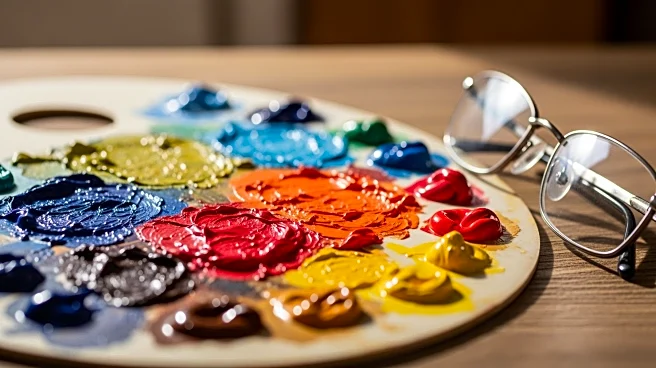
Fernando Dávila, a 72-year-old artist from Colombia, has gained recognition for his vibrant paintings despite being colorblind. Dávila's condition, which makes it difficult to distinguish between certain colors, particularly red and green, has not deterred him from pursuing his passion for art. Initially, he painted only in black and white until he was around 30 years old. Since the mid-1980s, he has been able to paint in color with the help of specially designed glasses. These glasses, developed by an ophthalmologist in New York, feature one transparent lens and one shaded red lens, allowing him to see almost two-thirds of the colors. Dávila's work has been exhibited in South America, Europe, and the United States, and he has been honored with the 'Order
of Democracy' by the Colombian Congress for his contributions to the arts.
Why It's Important?
Dávila's story highlights the intersection of art and technology, demonstrating how adaptive tools can enable individuals with disabilities to pursue their passions and achieve success. His journey underscores the importance of accessibility in the arts, encouraging innovation in assistive technologies. Dávila's achievements also bring attention to the challenges faced by colorblind individuals, a condition that affects a significant portion of the population. By overcoming these challenges, Dávila serves as an inspiration to others with similar conditions, showing that limitations can be transformed into unique artistic perspectives. His work not only enriches the cultural landscape but also promotes inclusivity and diversity in the art world.
What's Next?
Dávila continues to create and exhibit his work, contributing to the global art scene. His ongoing success may inspire further advancements in assistive technologies for artists with disabilities. As awareness of colorblindness and other visual impairments grows, there may be increased support for artists facing similar challenges. Dávila's story could lead to more inclusive art programs and initiatives, encouraging a broader range of voices and perspectives in the arts. Additionally, his recognition may prompt further exploration of how technology can enhance artistic expression for those with disabilities.
Beyond the Headlines
Dávila's experience raises questions about the role of perception in art and how different perspectives can enrich the artistic experience. His ability to convey emotion and vibrancy despite his colorblindness challenges traditional notions of color use in art. This could lead to a broader discussion about the subjective nature of art and how personal experiences shape artistic expression. Dávila's work also highlights the potential for art to serve as a bridge between different cultures and experiences, fostering greater understanding and appreciation of diverse perspectives.