
What's Happening?
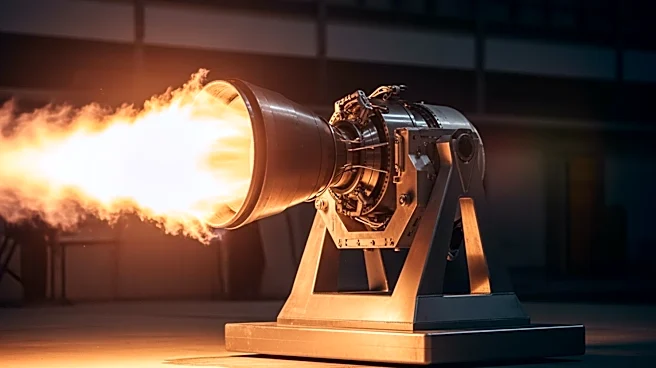
SpaceX has successfully ignited 33 Raptor 3 engines in a Super Heavy static fire test, marking a significant milestone for the Starship V3, which is set to become the world's most powerful rocket. This
test, conducted on May 7, 2026, at SpaceX's Starbase in Boca Chica, Texas, is part of the preparations for the first flight scheduled for May 12. The Starship V3, an evolution of the original Starship architecture, boasts a thrust at liftoff that surpasses the Saturn V, the rocket that carried the Apollo missions. The Raptor 3 engines provide more thrust and efficiency than previous versions, and the rocket's design includes lengthened propellant tanks to increase its payload capacity to low Earth orbit. SpaceX aims to place over 100 tons of payload into orbit, significantly reducing the cost per kilogram compared to previous space missions.
Why It's Important?
The successful ignition of the Raptor 3 engines and the upcoming launch of the Starship V3 represent a major advancement in rocket technology, potentially revolutionizing the space industry. By achieving a thrust greater than the historic Saturn V, SpaceX is setting a new standard for reusable rockets, which could drastically lower the cost of space travel. This development is crucial for the future of satellite deployment, scientific missions, and commercial space endeavors, as it makes previously unfeasible missions more accessible. Additionally, the Starship V3 is integral to NASA's Artemis program, which plans to use a version of the Starship as a lunar lander. The success of this rocket could also accelerate SpaceX's plans for Mars exploration, with uncrewed landings targeted for the 2028 transfer window.
What's Next?
The next step for SpaceX is the scheduled launch of the Starship V3 on May 12, pending final FAA licensing. This launch will test the new V3 architecture, including a deliberate splashdown to validate the design before attempting more complex recovery methods. SpaceX is also preparing for potential weather-related delays, with backup launch windows on May 13 and 14. The company continues to focus on engineering advancements, while the space industry and investors closely monitor the progress, as each successful test enhances SpaceX's valuation and potential for a future IPO.
Beyond the Headlines
The implications of the Starship V3 extend beyond immediate technological achievements. The reduction in launch costs could democratize access to space, enabling a broader range of scientific and commercial activities. This shift could lead to increased competition and innovation within the space industry, as other companies strive to match SpaceX's capabilities. Furthermore, the success of the Starship V3 could influence international space policy and collaboration, as countries and private entities reassess their strategies in light of SpaceX's advancements.