


What's Happening?
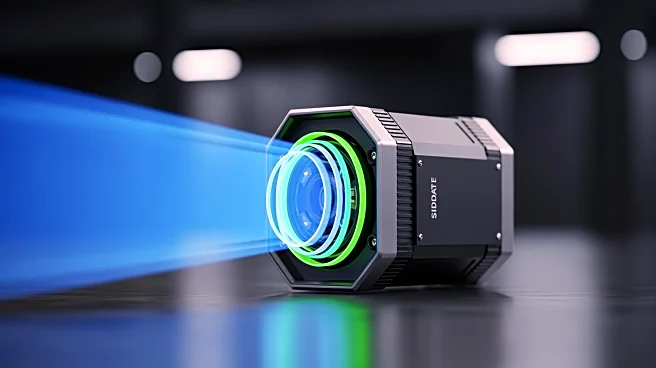
Voyant Photonics has unveiled the Helium platform, marking a significant advancement in LiDAR technology with the introduction of the first fully solid-state 4D Frequency-Modulated Continuous-Wave (FMCW) LiDAR sensors. Built on a silicon photonics chip, this platform utilizes a Photonic Integrated Circuit (PIC) to achieve high integration and reliability, particularly beneficial for robotics, industrial automation, and mobile autonomy. The Helium platform eliminates the need for moving parts, such as MEMS or mirrors, by employing a dense two-dimensional photonic focal plane array with integrated on-chip beam steering. This innovation results in a compact, rugged module that supports multi-sensor configurations, allowing for both wide and narrow
fields of view. The platform is designed to be as small as a matchbox, with a mass of less than 150 grams, making it ideal for drones and compact mobile robots.
Why It's Important?
The introduction of the Helium platform by Voyant Photonics represents a pivotal development in the field of LiDAR technology, offering significant implications for various industries. By providing a compact, cost-efficient, and highly reliable sensor, the platform addresses the growing demand for advanced sensing solutions in industrial and consumer markets. The ability to integrate this technology into machines via module-only access could lead to the creation of new classes of intelligent machines, enhancing automation capabilities across sectors. Furthermore, the platform's design, which allows for a projected 20-fold improvement in Mean Time Between Failures (MTBF) compared to traditional LiDAR systems, promises increased operational efficiency and reduced maintenance costs.
What's Next?
Voyant Photonics is opening an early access program for select automation partners and OEMs to explore custom chip resolutions and multi-sensor fusion architectures. This initiative is expected to foster collaboration and innovation, potentially leading to the development of tailored solutions that meet specific industry needs. The first prototype of the Helium platform is scheduled for demonstration at CES 2026 in Las Vegas, providing an opportunity for stakeholders to witness its capabilities firsthand. As the platform moves towards commercialization, it is likely to attract interest from various sectors looking to enhance their automation and sensing technologies.