



What's Happening?
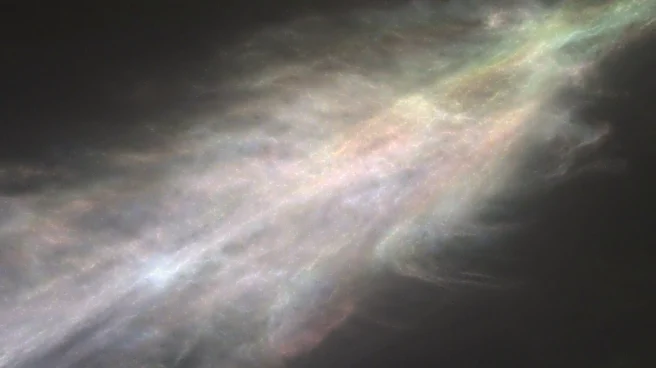
Noctilucent clouds, one of the sky's rarest phenomena, are currently visible in the northern hemisphere. These clouds, composed of tiny ice water crystals, form in the mesosphere about 50 miles above Earth's surface. Their high altitude allows them to
reflect sunlight long after sunset and before dawn, creating a striking visual effect against the twilight sky. Recent sightings have been reported in locations such as Kennewick, Washington, and Flensburg, Germany. The noctilucent cloud season typically runs from mid-May to mid-August, with peak visibility in July.
Why It's Important?
The appearance of noctilucent clouds offers a unique opportunity for skywatchers and photographers to capture rare atmospheric phenomena. These clouds are not only visually stunning but also provide valuable insights into atmospheric conditions at high altitudes. Studying noctilucent clouds can enhance understanding of climate patterns and the impact of human activities on the upper atmosphere. For enthusiasts and scientists alike, these clouds represent a fascinating intersection of natural beauty and scientific inquiry.
What's Next?
As the noctilucent cloud season progresses, more sightings are expected, particularly in regions between 45 and 80 degrees north latitude. Skywatchers are encouraged to look towards the western sky after sunset for the best chance of observing these clouds. Continued monitoring and documentation of noctilucent clouds will contribute to ongoing research efforts. Enthusiasts are invited to share their observations and photographs with scientific communities to aid in data collection and analysis.