
What's Happening?
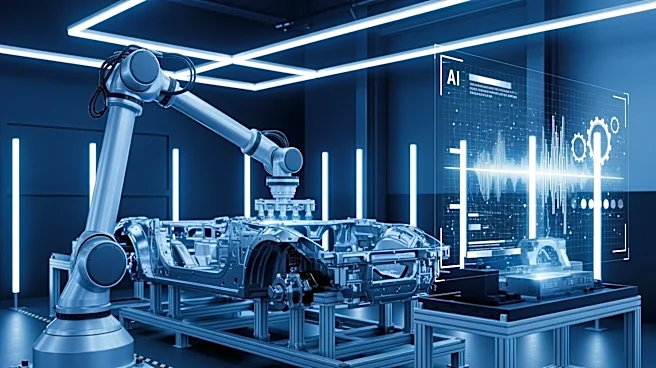
The automotive industry, which operates the densest fleet of industrial robots globally, is increasingly turning to artificial intelligence (AI) to improve predictive maintenance. Traditional maintenance programs
in automotive plants are designed for static equipment, which generates consistent vibration signatures. However, industrial robots, with their dynamic movements and varying tasks, do not fit this model. As a result, standard condition monitoring often fails to detect real wear and tear, leading to reliance on scheduled maintenance and run-to-failure strategies. AI offers a solution by continuously analyzing data recorded by robot controllers, such as force, speed, and position, to establish a baseline of normal operations. This allows AI to detect subtle changes in patterns that indicate potential failures before they become visible, thus improving maintenance accuracy and efficiency.
Why It's Important?
The integration of AI in predictive maintenance is crucial for the automotive sector, which stands to gain significantly from improved uptime and cost efficiency. By leveraging AI, automotive plants can reduce unexpected downtimes and extend maintenance intervals, leading to substantial productivity gains. This shift not only enhances operational efficiency but also reduces maintenance costs and prolongs the lifespan of robotic equipment. As the automotive industry continues to expand its use of robots, the ability to predict and prevent failures becomes increasingly important. The adoption of AI-driven maintenance strategies could set a new standard in the industry, influencing other sectors to follow suit.
What's Next?
For most automotive plants, the immediate step is to ensure that the data collected by robot controllers is effectively utilized. This involves auditing current data flows to identify and address any gaps in data architecture. By connecting existing data to AI systems, plants can begin to realize the benefits of predictive maintenance. This process is expected to uncover quick wins, such as identifying robots that have been logging anomalies without intervention and optimizing maintenance schedules based on actual wear and tear. As more plants adopt AI-driven maintenance, the industry could see a significant shift towards more proactive and efficient maintenance practices.